
Socket Preservation
The moment a tooth comes out, the bone around its socket starts to shrink. A graft placed at the extraction keeps the ridge full, and your options open.
- Visits
- One, at the time of extraction
- Anesthetic
- Local
- Healing
- Soft tissue closes in 1 to 2 weeks
- Ready for an implant
- After several months of bone maturation
Every service is quoted up front, before we start. All PPO insurances accepted.
The service
Protect the socket, protect the plan.
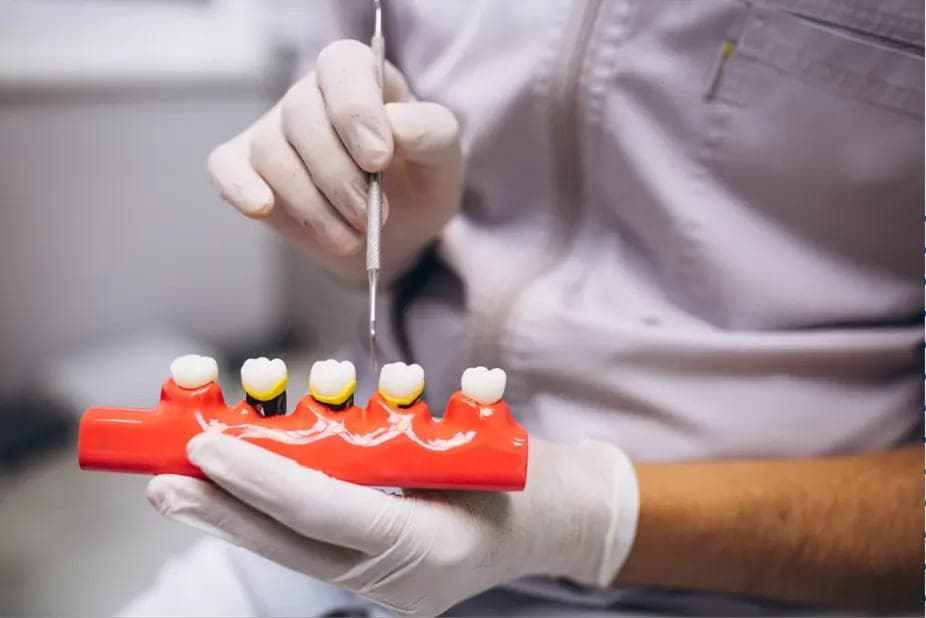
When a tooth is extracted the bone and gum around the empty socket can shrink and recede quickly, leaving a dent in the jaw line and, in the front of the mouth, a visibly sunken lip or cheek. Those defects make every later repair harder, whether the plan is an implant, a bridge or a denture.
Socket preservation, also called alveolar ridge preservation, heads this off. As the tooth comes out, the socket is filled with bone or a bone substitute and covered with gum, an artificial membrane or tissue, and your body's own repair does the rest. The healed socket keeps its width and height and gives a future implant a ready foundation.
If a tooth is coming out, ask whether socket preservation makes sense for you. It matters most when the tooth is a front one, or when an implant may follow.
What happens
Done in the same visit as the extraction.
Extraction
The tooth is removed under local anesthetic, as gently as possible to spare the socket walls.
The graft
The socket is filled with bone or a bone substitute, chosen for your case.
Sealing and healing
The site is covered with gum, an artificial membrane or tissue, and left to repair. Soft tissue closes over in 1 to 2 weeks; the bone matures over the following months.
Is it for you
Worth asking about if.
You do not need to match every line. Any one of them is reason enough to ask.
- A tooth is scheduled to come out and an implant may follow
- The extraction is in the front, where the gum line shows
- You have not decided on a replacement and want options kept open
- A previous extraction site has sunken in
Afterwards
The first weeks.
Expect the same recovery as a straightforward extraction: some discomfort once the anesthetic wears off, covered by over-the-counter pain relief or a prescription if needed. Keep to soft food, keep the area clean as instructed, and do not disturb the covering while the gum closes over the first 1 to 2 weeks.
Underneath, the graft matures into solid bone over several months. Follow-up visits confirm when the site is ready for an implant or whatever replacement you choose.
Call the office if:
- Bleeding does not settle with gentle pressure
- Pain or swelling worsens after the third day
- The covering comes away from the socket
- You develop a fever or a bad taste that will not rinse away
Common questions
Answering your questions.
Why not just let the socket heal on its own?
It will heal, but the ridge loses width and height as it does. That can rule out an implant later without further grafting, and in the front of the mouth it shows as a sunken gum line.
What goes into the socket?
Your own bone (autograft), processed donor bone (allograft), animal-derived bone, usually bovine (xenograft), or a synthetic material (alloplast), chosen for your case.
Does it hurt?
It is done under local anesthetic during the extraction itself, so there is no extra procedure to sit through. Afterwards it feels much like a normal extraction and settles with ordinary pain relief.
How long before I can have the implant?
The gum closes in 1 to 2 weeks, but the bone needs several months to mature. Your follow-up visits confirm exactly when the site is ready.
Your first visit
One ticket covers it.
360 Dental · Admit one