
Restorative Dentistry
Failed Root Canal: Symptoms, Causes & What Happens Next
Published 8 min read

A failed root canal is when the treated tooth keeps hurting or gets infected again weeks, months, or even years after the original procedure. At 360 Dental in Van Nuys, patients usually come to us worried that something went wrong the first time around.
Most of the time, that is not the full story. Root canals are highly effective. But no dental procedure works 100 percent of the time. Our root canal therapy team, led by in-house endodontist Dr. Mansouri, treats this exact problem often.
This guide covers what it looks like, why it happens, and what your options are if it happens to you.
What Is a Failed Root Canal?
A failed root canal happens when the treated tooth becomes reinfected or keeps hurting because bacteria remained inside it, or a new crack let bacteria back in. It does not always mean something went wrong during the original treatment.
Root canals treat infected or damaged pulp inside a tooth, then seal it off to keep bacteria out, according to MouthHealthy.org. Most of the time, that seal holds for good. But teeth have a complex network of tiny canals, and a few can be difficult to reach even with modern imaging. When one gets missed, infection can quietly return.
Molars are usually the trickiest teeth in this regard. They often have three or four canals instead of one, sometimes curved or branching in ways an x-ray does not fully show. That complexity is part of why an experienced endodontist matters, especially for a second attempt at treatment.
Think of a root canal as sealing off a small room inside the tooth so bacteria cannot get back in. Most of the time that seal holds for good. Regular exams help catch small problems early, too. Routine visits catch 80% of oral health issues before they turn urgent, according to the ADA.
How Common Is It?
Failure is not the norm. Most root canals succeed the first time and last for years, sometimes decades. When problems do show up, they often surface within the first year, though a failure can technically happen much later if a new crack or cavity forms.
If you notice ongoing discomfort or something feels off, call our Van Nuys office. A quick exam and an X-ray usually settle the question fast.
That quick exam matters more than people expect. An x-ray can show infection at the root tip long before you would feel it in a bite test, and catching it there keeps your options wide open.
What Are the Signs of Complications After a Root Canal?
Signs of complications after a root canal include lingering discomfort, swelling, a small pimple-like bump on the gum, or sensitivity when you bite down weeks or months later. Any of these deserve a follow-up visit, not a wait-and-see approach.

Here is what to watch for after any root canal:
- Discomfort that lingers past the first week or comes back later
- Swelling in the gum near the treated tooth
- A small bump on the gum that drains or comes and goes
- Sensitivity to pressure or temperature that was not there before
- A tooth that darkens or feels loose
A tooth abscess will not resolve on its own. It is a pocket of pus caused by bacterial infection, according to the Mayo Clinic, and it needs professional treatment, not home remedies.
If you notice any of these signs, do not wait for them to pass on their own. Call our Van Nuys office and describe what you are feeling. A quick exam and an X-ray usually tell us right away whether the tooth needs retreatment or something else.
Can a Root Canal Fail, and What Causes It?
Yes, a root canal can fail, most often because of a missed canal, a new crack, a delayed crown, or a fresh cavity that reopens the tooth to bacteria. Complex tooth anatomy is one of the most common reasons treatment does not fully seal out infection.
- A hidden or curved canal that was not fully cleaned
- A crack that develops after treatment and lets bacteria back in
- A crown or filling placed too long after the procedure
- A new cavity that reaches the same tooth
- A breakdown of the seal at the root tip over time
None of these causes mean the original treatment was rushed or careless. Tooth anatomy varies a lot from patient to patient, and some canals are simply harder to reach than others.
Dr. Mansouri, our in-house endodontist, has handled these cases for nearly 20 years in private practice. Getting a crown placed promptly after treatment, and keeping up with regular exams, lowers the odds of most of these causes.
How to Lower the Risk
- Get your permanent crown placed soon after the root canal, not months later
- Keep up with regular checkups so a new cavity gets caught early
- Mention any new discomfort right away instead of waiting it out
Not sure if your tooth is healing right?
Call our Van Nuys office and we will take a look before it gets worse.
Call (818) 787-6400 →
What Happens If a Root Canal Fails?
If a root canal fails, the infection can return and spread into the bone around the root, sometimes forming a new abscess. Left alone, it will not resolve on its own, and it usually gets more uncomfortable over time.
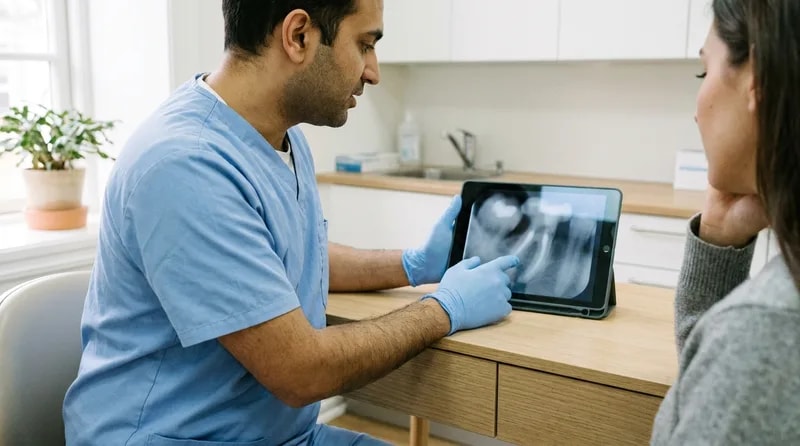
An infection like this does not stay contained forever. Dental problems send about 2 million people to hospital emergency rooms every year, according to the ADA Health Policy Institute. A spreading tooth infection is one of the common reasons why. That is a real risk. It is also avoidable with prompt treatment.
The good news is that catching it early keeps your options open. A tooth caught soon after symptoms return usually has a much better shot at being saved than one that sits untreated for months.
Waiting rarely makes things easier. Discomfort tends to build gradually, then suddenly. That is why so many root canal failures end up as same-day emergency visits instead of planned appointments.
We would rather see you for a planned visit. It gives us more room to talk through options calmly, instead of making a quick decision under pressure.
What Are Your Options for Failed Root Canal Therapy?
If a root canal fails, options usually include retreatment, an apicoectomy, or extraction followed by an implant or bridge. Which option fits best depends on the tooth condition, the type of failure, and what Dr. Mansouri finds on imaging.
| Option | What It Involves | Best For |
|---|---|---|
| Retreatment | Reopening the tooth to clean out infection and reseal it | Teeth with a missed canal or a fixable crack |
| Apicoectomy | Minor surgery to remove infection at the root tip | Teeth with a crown that should not be disturbed |
| Extraction and implant | Removing the tooth and replacing it with an implant | Teeth that are too damaged or cracked to save |
Dental implants have a success rate of 95-98% over 10 years, according to the Journal of Oral and Maxillofacial Surgery, which makes extraction and replacement a strong option when a tooth truly cannot be saved. Implant-supported teeth can also restore up to 90% of natural chewing power, per the AAID.
Dr. Mansouri usually starts with the least invasive option that can realistically work. Retreatment comes first when the tooth structure is sound. Extraction only comes up when the tooth is cracked below the gumline or the bone around it has broken down too far to support another repair.
It is normal to feel uneasy about a second procedure. A 2024 BMC Oral Health study found that 36% of Americans report some dental anxiety, and retreatment is done under the same comfortable local anesthesia as the original visit.
Related: If you are weighing a root canal against extraction right now, our guide on whether root canals hurt walks through what the procedure actually feels like. Read that guide →
If extraction ends up being the right call, our dental implants team can walk you through timing and options the same day.
Get Help for a Failed Root Canal in Van Nuys
This is not something to sit with. Catching it early almost always means more options and a simpler fix, whether that is retreatment or something else entirely.
Staying consistent with checkups afterward matters too. Patients who see a dentist regularly are 60% less likely to lose teeth later in life, according to the Journal of Dental Research.
If your treated tooth still hurts, feels swollen, or just does not feel right, call 360 Dental and let Dr. Mansouri take a look. A short visit now usually beats a bigger problem later.
Results may vary. Please consult with your dentist at 360 Dental for personalized treatment recommendations.
Do not ignore a tooth that still hurts.
Our in-house endodontist can evaluate the problem and walk you through your options.
Prefer to talk to someone first?
Call (818) 787-6400 →
Common questions
What is a failed root canal?
A failed root canal is a treated tooth that becomes reinfected or keeps hurting weeks, months, or years after treatment. It usually happens because bacteria remained inside the tooth or a new crack let bacteria back in.
Can a root canal fail years later?
Yes, a root canal can fail years later, usually because a new cavity or crack reopens the tooth to bacteria. This is different from an early failure, which often points to a missed canal during the original treatment.
What happens if a root canal fails?
If a root canal fails, the infection can return and spread into the bone around the root, sometimes forming a new abscess. Left untreated, it will not resolve on its own and tends to get worse over time.
How do I know if my root canal failed?
Signs of complications after a root canal include lingering discomfort, swelling, a small bump on the gum, or new sensitivity when biting down. Any of these signs are worth a follow-up exam and x-ray.
Is retreatment or extraction better for a failed root canal?
Retreatment is usually tried first when the tooth structure is sound, since it saves the natural tooth. Extraction only becomes the better option when the tooth is too cracked or the surrounding bone is too damaged to repair.
Does a failed root canal always hurt?
Not always. Some failed root canals cause obvious discomfort or swelling, but others show up quietly as a small gum bump or mild sensitivity, which is why regular checkups and x-rays still matter after treatment.
Did this answer your question?
Written for general reading, not as advice about your own teeth. Nothing here replaces an examination: if something hurts, or has changed, book a visit and let a dentist look at it.
Read next
 13 min readWisdom Teeth Removal Recovery in Van Nuys: What to ExpectWisdom teeth removal recovery day by day: what to expect in the first 48 hours, what to eat, which symptoms need a call, and when you get back to normal.Read the article
 13 min readBotox for TMJ: How Jaw Tension Relief Works in Van NuysBotox for TMJ explained: which chewing muscles are treated, how long relief lasts, the off-label status, risks, and what belongs in a jaw tension plan.Read the article
 13 min readDoes a Root Canal Hurt? What to Expect in Van NuysDoes a root canal hurt? What the appointment involves, how the tooth is numbed, recovery, and why the treatment relieves the problem it gets blamed for.Read the article
Your first visit
One ticket covers it.
360 Dental · Admit one