
Restorative Dentistry
Wisdom Teeth Removal Recovery in Van Nuys: What to Expect
Published 13 min read

Most questions about wisdom teeth removal recovery are really one question: how long will I feel rough, and how will I know if something is wrong? That is a fair thing to want answered before you book anything. Extractions sit inside general and preventive care at 360 Dental in Van Nuys, alongside bone grafting and socket preservation.
The useful thing to understand up front is that healing does not move in a straight line. Soreness and swelling usually build first, then ease. Day two feeling worse than day one is normal, and not knowing that is what sends people into a spiral of worry on a Tuesday night.
This guide walks the arc day by day, then covers what to eat, which symptoms deserve a phone call, and how to schedule the whole thing so you are not managing a question on a Sunday.
What are the signs it is time for wisdom teeth removal?
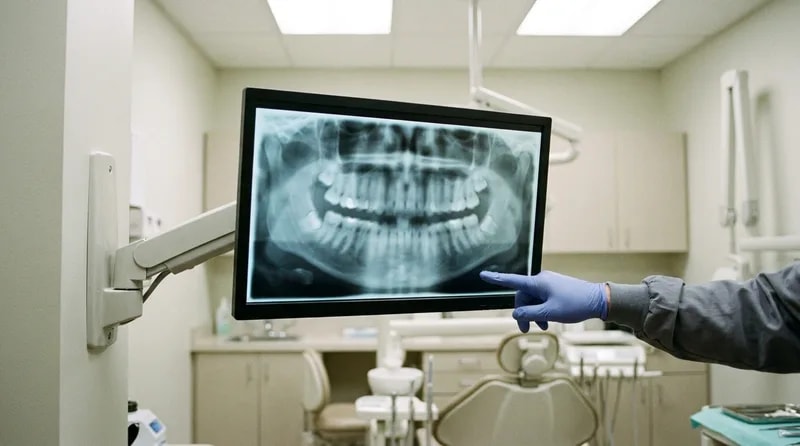
The usual signs are tenderness or swelling at the back of the jaw, food packing behind the second molar, a partly erupted tooth that cannot be cleaned properly, and pressure that comes and goes. Your dentist confirms the cause with a 3D CT scan rather than from symptoms alone.
Symptoms alone are unreliable here. A wisdom tooth can sit at an awkward angle for years without announcing itself, then flare up in a week. And the opposite happens too: a sore jaw is often grinding, not a third molar.
Signs worth mentioning at your next checkup
- Food trapping behind the last molar
- Tenderness that returns every few months
- Gum swelling around a partly erupted tooth
- Bad taste or odor near the site
- Difficulty opening fully
- Pressure that shifts across the jaw
Cleaning access is the quiet issue. A tooth you cannot reach with a brush is a tooth that collects plaque, and nearly 1 in 4 adults in the US already has untreated tooth decay, according to CDC NCHS. The NIH tracks how decay develops in surfaces that are hard to clean, which is exactly what a crowded third molar creates.
Do all wisdom teeth actually need to come out?
No. A wisdom tooth that has erupted fully, sits in a reasonable position, and can be brushed and flossed is often monitored at regular checkups instead of removed. Removal becomes the recommendation when the tooth is damaging its neighbor, trapping food, or repeatedly inflamed.
| Situation | Usual approach | What the dentist watches |
|---|---|---|
| Fully erupted, well positioned, cleanable | Monitor at routine checkups | Decay, gum health, bite changes |
| Partly erupted, gum flap over the tooth | Often removal | Repeat inflammation, food packing |
| Angled into the second molar | Usually removal | Damage to the neighboring tooth |
| Fully buried with no symptoms | Often monitor, sometimes remove | Position on 3D imaging, root proximity |
| Repeated swelling episodes | Removal usually recommended | Frequency and spread of swelling |
| Decay that cannot be restored | Removal | Whether the tooth is restorable at all |
Which is the honest case for waiting. Regular dental visits can catch 80% of oral health issues before they become serious, according to the ADA, and monitoring is a real clinical option rather than a delay tactic. The ADA patient guidance on wisdom teeth makes the same point: position and cleanability drive the decision, not age.
Gum health around the site matters as well. 42% of adults aged 30 and over have some form of periodontal disease, according to CDC 2024 figures, and a tooth you cannot clean makes that harder to manage. Americans who visit a dentist regularly are 60% less likely to lose teeth, according to the Journal of Dental Research, which is what makes monitoring credible. Ask what specifically would change the recommendation to remove.
What happens during the appointment itself?
The site is numbed with local anesthetic, the gum is eased back if needed, the tooth is removed in one piece or in sections, and the socket is cleaned and closed. Sutures are common. Most appointments are shorter than patients expect, and you go home the same day.
Nerves before an extraction are extremely common. 36% of Americans have dental anxiety and 12% have extreme dental fear, according to BMC Oral Health, 2024. Say so when you book. A team that knows in advance can pace the visit differently, and that is easier to arrange than most people assume.
What does wisdom teeth removal recovery look like day by day?
Expect a build-then-ease curve. Bleeding settles within hours, swelling peaks in the first couple of days, and soreness eases steadily from there. The socket keeps healing underneath for weeks after you feel normal again. Your own timeline depends on how many teeth came out and how they sat.

- Day 1Rest and clot protection
Keep gauze in place as directed, rest with your head slightly raised, and use a cold compress in short intervals. No straws, no smoking, no spitting, no vigorous rinsing. This day is about leaving the site alone.
- Days 2 to 3The peak
Swelling and stiffness usually feel worst here, and cheeks may look uneven. Gentle salt water rinsing typically begins now if your dentist advised it. Feeling worse than day one is expected rather than alarming.
- Days 4 to 7Clear improvement
Swelling recedes and jaw movement loosens. Most people return to routine activity in this window and reintroduce soft solids. Bruising, if any, fades through yellow before it disappears.
- Week 2Back to normal eating
Sutures dissolve or are removed. Chewing near the site becomes comfortable again for most people, though the socket still feels slightly different to the tongue.
- Weeks 3 to 4 and beyondQuiet healing
Gum tissue closes over and bone fills the socket gradually. You will not feel this stage happening, which is exactly the point. Keep the follow-up appointment anyway.
One caveat worth stating plainly. These are general patterns, not a schedule you should hold yourself to. Four teeth removed at once behaves differently from one, and your dentist knows which applies to you.
| How many were removed | Typical recovery shape | What to plan for |
|---|---|---|
| One, fully erupted | Shortest arc, least swelling | A quiet evening and soft food |
| One, angled or partly buried | More swelling than its size suggests | A full rest day, sutures likely |
| Two on the same side | Chewing shifts entirely to one side | Soft food for several days |
| All four at once | Longest arc, most swelling | A cleared schedule and a ride home |
How do you manage swelling and soreness in the first 48 hours?
Cold compresses in short intervals, head slightly raised, and rest do most of the work early on. Take any medication exactly as your dentist directed rather than improvising. The single most important rule is leaving the blood clot over the socket undisturbed.
- Cold, in intervals. Apply a cold compress to the outside of the cheek in short spells rather than continuously, following the timing your dentist gave you.
- Stay propped up. Lying completely flat tends to increase swelling overnight, so an extra pillow genuinely helps the first two nights.
- Medication as directed. The ADA publishes guidance on oral analgesics for dental procedures. Follow your dentist's specific instructions and do not double up on products without asking.
- Hydrate, from a glass. Drink plenty, but never through a straw. Suction is what dislodges the clot.
- Rest properly on day one. Not a light day at work. An actual day of rest, which shortens the whole curve.
First 24 hours: leave these alone
- Straws
- Smoking or vaping
- Spitting
- Vigorous rinsing
- Hot drinks
- Strenuous exercise
- Poking the site with your tongue
Dry socket is the complication most of these rules exist to prevent. It happens when the clot is lost too early and the socket is left exposed, and MouthHealthy from the ADA describes it as notably more uncomfortable than ordinary healing. It is also largely avoidable, which is why the list above is short and strict.
Questions in the first few days after an extraction?
Call 360 Dental in Van Nuys at (818) 787-6400 during office hours rather than guessing. Post-operative questions are routine, not an imposition.
- Myth
Swelling on day two means the extraction went badly.
- Reality
Swelling builds after treatment rather than peaking immediately. Day two is usually the high point, not a warning.
- Myth
Once the soreness fades, healing is finished.
- Reality
The socket keeps filling in for weeks after you feel normal, which is why the follow-up still matters.
What can you eat while you recover?
Start cool and soft, then add texture as comfort allows. Yogurt, cooled blended soups, smoothies eaten with a spoon, and mashed foods carry you through the first day or two. Nutrition matters more than most people expect, because healing tissue needs protein.

Cool and spoonable
First 24 to 48 hours
Yogurt, cooled soups, applesauce, mashed potato, scrambled egg, and smoothies taken with a spoon. Nothing hot, nothing that needs chewing, nothing drawn through a straw.
Skip: Straws, hot liquids, anything with seeds or grains.
Soft solids
Days 3 to 7
Pasta cooked soft, fish, soft rice, well-cooked vegetables, and oatmeal. Chew on the opposite side from the sockets and slow down more than feels necessary.
Skip: Crusty bread, chips, nuts, popcorn, tough meat.
Back to normal
Week 2 onward
Most foods return as chewing gets comfortable. Reintroduce crunchy textures last, and keep rinsing after meals until the sockets have fully closed over.
Skip: Anything that packs into the socket, until your dentist confirms it has healed.
- Cold foods early are useful twice over: comfortable, and they discourage bleeding.
- Skip alcohol while you are on any prescribed medication, and ask if you are unsure.
- Rinse gently with salt water after eating once your dentist says rinsing is allowed.
Which symptoms mean you should call your dentist right away?
Call if soreness increases after day three instead of settling, if swelling spreads toward the eye or neck, if you develop a fever, if bleeding will not stop with steady pressure, or if you cannot open your jaw. Direction matters more than intensity.
- 48 hours
Dental abscesses can spread to other parts of the body within 48 hours if untreated.
JADA
- 2 million
Emergency room visits per year in the US are for dental issues.
ADA Health Policy Institute
- 80%
Of oral health issues can be caught by regular dental visits before they become serious.
ADA
Swelling with fever belongs in a different category from ordinary soreness. Infection does not resolve on its own schedule, and the same-day emergency dentistry route exists precisely so this does not turn into an emergency room visit that cannot treat the tooth anyway.
Related: Knowing which symptoms cannot wait until the office reopens is worth reading before your appointment, not after. General dentistry at 360 Dental →
When can you go back to work, school, or the gym?
Most people manage desk work or classes within a couple of days, while strenuous exercise usually waits longer because raised blood pressure can disturb the healing site. Physical jobs need more time than office ones. Ask your dentist about your specific situation before you plan around it.
- Myth
Recovery means a week off work.
- Reality
Most people are back to ordinary activity well before that. It is strenuous exertion, not attendance, that needs the longer pause.
- Myth
If I feel fine on day two, I can go to the gym.
- Reality
Feeling fine and being healed are different things. The clot is still fragile even when soreness has faded.
- Myth
Sleeping it off flat is the best way to recover.
- Reality
Lying completely flat tends to make overnight swelling worse. Propping your head up is the more comfortable choice.
Plan the return, do not improvise it. If your work involves lifting, heat, or contact, say so when you book so the timing conversation happens before the appointment rather than after.
How do you plan wisdom teeth removal recovery around your schedule in Van Nuys?
Book early in the week so your first few recovery days fall inside office hours. 360 Dental is open Monday to Thursday until 5:30 PM and Friday until 4:00 PM, closed weekends. A Monday or Tuesday appointment keeps the critical window reachable by phone.
Before your appointment
Check each item you have sorted out in advance.
I have booked early in the week rather than on a Friday.
I have someone who can drive me home if needed.
I have soft, cool food in the fridge already.
I have told the office about any anxiety or medications.
I know the number to call with questions: (818) 787-6400.
I have cleared strenuous activity from the next several days.
Your score: count your checks out of 6.
Planning your visit at 360 Dental in Van Nuys
- Where
6301 Van Nuys Blvd, Van Nuys, CA 91401, at the corner of Van Nuys Blvd and Victory Blvd, minutes off the 405 and 101.
- Hours
Monday to Thursday, 8:30 AM to 5:30 PM. Friday, 8:30 AM to 4:00 PM. Closed Saturday and Sunday.
- Languages
English, Spanish, and Armenian spoken at the front desk.
- On site
Tooth extractions, bone grafting and socket preservation, plus 3D CT and iTero digital scanning.
- Serving
Van Nuys, Sherman Oaks, North Hollywood, Encino, Panorama City, Valley Glen, Studio City, and Reseda.
- Phone
(818) 787-6400. Rated 4.9 stars on Google with more than 460 Yelp reviews.
The practice is an all-digital, one-stop office: founder Dr. Vachik Danoukh, DMD covers general and cosmetic treatment, and endodontist Dr. Parham Mansouri, DDS, MS handles root canal therapy on site. Fewer referrals out means fewer separate appointments to coordinate around your recovery.
The most useful thing to carry into wisdom teeth removal recovery is the shape of the curve. Worse before better is normal. Better then worse is the signal.
Protect the clot, eat soft and cool at first, and keep the phone number close for the first week. If you are still deciding whether removal is needed at all, ask what happens if you monitor instead.
Results may vary. Please consult with your dentist at 360 Dental for personalized treatment recommendations.
Get your wisdom teeth assessed before they flare up
A checkup with 3D imaging at 360 Dental in Van Nuys shows exactly where each tooth sits, so removal is a decision rather than an emergency.
Already scheduled, or recovering and unsure about a symptom? Call (818) 787-6400 during office hours and the team will talk it through.
Common questions
How long does wisdom teeth removal recovery take?
Most people manage daily activity again within a few days, while the socket itself continues healing for several weeks underneath. The arc is gradual rather than sudden. Your dentist gives you a timeline based on how many teeth were removed and how they were positioned.
Why does day two feel worse than day one?
Swelling builds after treatment rather than starting at its peak, so day two often feels more tender than the first evening. That pattern is expected. What matters is the direction after day three: steady improvement rather than a return of increasing soreness.
What is dry socket, and how do you avoid it?
Dry socket happens when the protective blood clot over the site is dislodged too early, leaving the socket exposed. Avoid straws, smoking, spitting, and vigorous rinsing for the first day. Follow the specific instructions your dentist gives you rather than general advice.
Can I brush my teeth after wisdom teeth removal?
Yes, but treat the surgical sites as off limits at first. Brush your other teeth normally and keep the toothbrush away from the sockets until your dentist says otherwise. Gentle salt water rinsing usually starts the following day, not immediately.
When can I go back to the gym?
Most dentists ask you to skip strenuous exercise for the first several days, because raised blood pressure can disturb the healing site. Walking is usually fine sooner. Ask specifically about lifting and contact sports, since those carry different considerations.
Do all wisdom teeth need to be removed?
No. Wisdom teeth that are fully erupted, positioned well, and cleanable can often be monitored at regular checkups instead. Removal becomes the recommendation when the tooth is trapping food, damaging its neighbor, or repeatedly inflamed.
What should I eat during wisdom teeth removal recovery?
Start with cool, soft foods that need no chewing, like yogurt, smoothies eaten with a spoon, and blended soups once cooled. Add soft solids as comfort allows. Avoid anything crunchy, seedy, or very hot until the sockets have settled.
Does 360 Dental in Van Nuys handle extractions on site?
Yes. Tooth extractions, along with bone grafting and socket preservation, are handled at 360 Dental at 6301 Van Nuys Blvd. Call (818) 787-6400 to ask what your specific case involves and how your visit would be scheduled.
Did this answer your question?
Written for general reading, not as advice about your own teeth. Nothing here replaces an examination: if something hurts, or has changed, book a visit and let a dentist look at it.
Read next
 13 min readBotox for TMJ: How Jaw Tension Relief Works in Van NuysBotox for TMJ explained: which chewing muscles are treated, how long relief lasts, the off-label status, risks, and what belongs in a jaw tension plan.Read the article
 13 min readDoes a Root Canal Hurt? What to Expect in Van NuysDoes a root canal hurt? What the appointment involves, how the tooth is numbed, recovery, and why the treatment relieves the problem it gets blamed for.Read the article
Your first visit
One ticket covers it.
360 Dental · Admit one