
Restorative Dentistry
Does a Root Canal Hurt? What to Expect in Van Nuys
Published 13 min read

Does a root canal hurt? It is the most searched question in dentistry, and the honest answer frustrates people because it sounds like marketing: for most patients, the appointment itself is comfortable. Root canal therapy at 360 Dental in Van Nuys is done with the tooth fully numbed, on site, by an endodontist.
Here is the part that explains the reputation. Patients arrive with a tooth that has been aching for days or weeks. The treatment resolves it. But the memory of that week attaches itself to the appointment rather than to the infection, and the procedure gets blamed for the problem it fixed.
Below is what actually happens, how the numbing works, what the days afterward feel like, and when extraction is the more sensible route instead.
Does a root canal hurt during the procedure?
For most patients it does not. The tooth and surrounding tissue are numbed with local anesthetic before anything begins, and your dentist confirms the area is fully numb first. Most people describe the appointment as long rather than difficult.
The sensation to expect is pressure and vibration rather than sharpness. If you feel anything sharp, that means more anesthetic is needed, and saying so immediately is the correct response rather than enduring it.
Worth knowing how common the underlying problem is, because patients often assume they are an unusual case. Nearly 1 in 4 adults in the US has untreated tooth decay, according to CDC NCHS, and untreated decay is the usual route to needing this treatment at all.
What patients most often report afterward
- Easier than expected
- Longer than expected
- Pressure rather than sharpness
- Relief within a day or two
- Jaw stiffness from staying open
- Tenderness when biting for a few days
ADA patient information on root canals describes the treatment as a way to save a tooth that would otherwise be lost, which is a useful frame. It is a repair procedure, and the discomfort it is famous for mostly belongs to the condition that made it necessary.
Why do root canals have such a bad reputation?
Three reasons: older techniques were genuinely harder, anesthetic was less effective decades ago, and patients confuse the infected tooth beforehand with the treatment that resolved it. Word of mouth then carries the old version forward long after the practice changed.
- Myth
A root canal is one of the worst things a dentist does.
- Reality
Most patients report the appointment as comfortable but long. The reputation predates modern anesthetic and instruments.
- Myth
The procedure caused the soreness I remember.
- Reality
The infection caused it. The treatment is what stopped it, usually within a day or two of the appointment.
- Myth
You can wait until it really becomes unbearable.
- Reality
Infection spreads rather than resolves. Waiting often reduces the chance that the tooth can be saved at all.
Anxiety about this is not irrational, and it is extremely widespread. 36% of Americans have dental anxiety and 12% have extreme dental fear, according to BMC Oral Health, 2024. If that is you, say so when you book rather than on arrival, because a team that knows in advance can pace the appointment differently.
What actually happens during root canal treatment?
The tooth is numbed and isolated, an opening is made through the top, the infected tissue inside is cleaned out, the canals are shaped and disinfected, then sealed. The tooth is restored afterward, often with a crown, in the same visit or a later one.
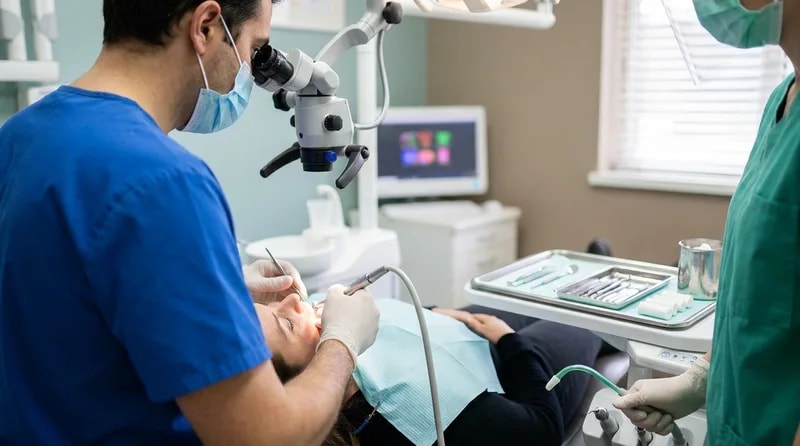
That last step is the one patients skip and later regret. A sealed canal system with no crown on a molar is a tooth waiting to split. Ask when the restoration is scheduled before you leave the first appointment.
| Which tooth | Usually affects |
|---|---|
| Front tooth or canine | Fewer canals, so a shorter appointment |
| Premolar | Moderate, often one visit |
| Molar | More canals, longer appointment, crown usually advised |
| Previously treated tooth | Assessed for retreatment with imaging first |
How does the numbing work, and what if it does not?
Local anesthetic blocks sensation in the nerve supplying that tooth and the surrounding tissue. Your dentist tests the area before starting. A badly inflamed tooth can be harder to numb fully, in which case additional anesthetic is given rather than pressing on.
It also helps to know what the numbing does not cover. Anesthetic removes sensation from the tooth, not the awareness of pressure or the sound of instruments. Patients who expect to feel nothing at all sometimes read ordinary pressure as a sign the anesthetic failed. Knowing the difference in advance makes the appointment noticeably easier to sit through.
Heavily infected teeth are the genuine exception to smooth numbing, and there is no point pretending otherwise. Inflamed tissue responds less predictably to anesthetic. That is a specific, solvable problem your dentist manages with technique and additional anesthetic, not a reason to avoid treatment.
What does recovery feel like afterward?
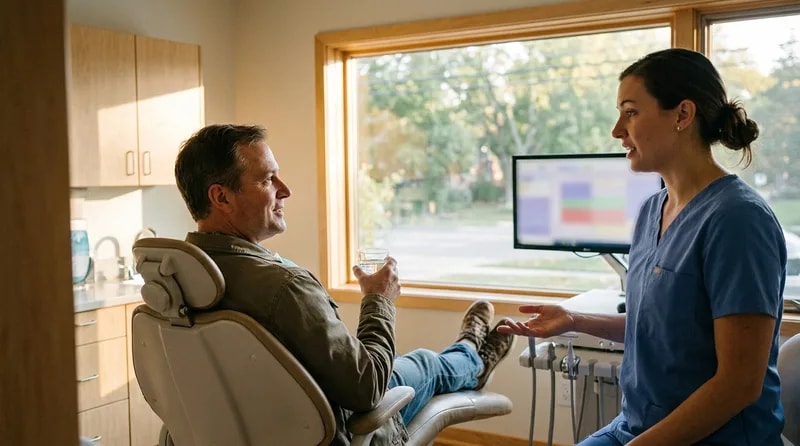
Expect tenderness when biting on that tooth for a few days, easing steadily. Jaw stiffness from holding your mouth open is common and unrelated to the tooth. Most people return to normal activity the same day and normal eating within a day or two.
- Day 1
The first evening
Numbness wears off over a few hours. Avoid chewing on that side until sensation returns fully. Mild tenderness beginning as the anesthetic fades is expected.
- Days 2 to 3
Settling
Tenderness on biting is normal and should ease each day. Take any relief your dentist recommended as directed rather than improvising.
- Days 4 to 7
Back to normal
Most people stop noticing the tooth in this window. Continue avoiding hard chewing on it until the permanent restoration is placed.
- As scheduled
Restoration
The crown or permanent filling protects the tooth long term. Keep this appointment even though the tooth already feels fine.
| What you notice | Normal after treatment | Call the office |
|---|---|---|
| Tenderness on biting | Eases a little each day | Increases after day three |
| Swelling | None, or very slight and settling | Growing, or spreading toward eye or neck |
| Temperature | Normal | Any fever |
| Taste or odor | Normal | A bad taste appearing days later |
| The temporary filling | Stays in place | Comes loose or falls out |
| Jaw stiffness | Common, from holding open, eases in days | Cannot open your mouth properly |
The direction matters more than the intensity. Steadily improving is the normal pattern. Tenderness that climbs after the third day, swelling, or a fever are reasons to call rather than wait out.
Say these when you call about a toothache
- Which tooth, and for how long
- Whether there is any swelling
- Whether you have a fever
- Whether it wakes you at night
- Any anxiety about treatment
What happens if you delay treatment?
Infection inside a tooth does not resolve on its own. It progresses into the surrounding bone and soft tissue, an abscess can form, and the window in which the tooth can be saved narrows. Delay converts a treatable problem into an extraction.
48 hours
Dental abscesses can spread to other parts of the body within 48 hours if untreated.
JADA
2 million
Emergency room visits per year in the US are for dental issues.
ADA Health Policy Institute
80%
Of oral health issues can be caught by regular dental visits before they become serious.
ADA
- Decay reaches the nerve. Sensitivity to cold or sweetness appears, then may fade as the tissue inside dies.
- Infection establishes itself. The quiet phase is misleading, because the tooth stops signaling while bacteria continue.
- It spreads beyond the root. Surrounding bone becomes involved and the tooth may feel tender to bite on or slightly raised.
- An abscess forms. Swelling, and sometimes fever, which is the point at which this becomes urgent rather than schedulable.
- The tooth becomes unrestorable. Enough structure or support is lost that saving it is no longer realistic.
Swelling with fever belongs in a different category from a toothache. That is a same-day emergency dentistry situation rather than something to book for next week. And NIH information on tooth decay explains how decay reaches the nerve in the first place, which is the process root canal treatment interrupts.
Related: Knowing which symptoms cannot wait until the office reopens is worth reading before you need it. Emergency dentistry at 360 Dental →
When is extraction the better choice instead?
When the tooth is fractured below the gum, when too little structure remains to restore, when the root is badly damaged, or when repeated treatment has already failed. In those cases removing the tooth and planning a replacement is the more realistic path.
Save the tooth
Usually preferred when restorable
Your own tooth keeps its root, its position, and its relationship with neighbors. Nothing replaces a natural tooth exactly, which is why saving one is the default when it is realistic.
Skip: Assuming every tooth can be saved regardless of condition.
Extract and replace
When the tooth cannot be restored
Sometimes the honest answer. Removal is followed by a plan: an implant, a bridge, or in some cases accepting the gap. Ask what the full sequence and timeline would be.
Skip: Choosing this only because it seems simpler today.
Retreatment
When a previous root canal has failed
A tooth treated years ago can develop problems again. Retreatment is sometimes possible and is assessed by an endodontist with imaging rather than assumed either way.
Skip: Assuming a failed treatment means automatic extraction.
One figure worth having in mind if replacement is on the table. 120 million Americans are missing at least one tooth, according to the American College of Prosthodontists, and dental implants have a success rate of 95-98% over 10 years, according to the Journal of Oral and Maxillofacial Surgery. Replacement works well. It is still a longer road than keeping what you have.
Ask both questions in the same conversation: what does saving it involve, and what does replacing it involve. A recommendation that can lay out both paths honestly is one you can weigh.
Get the diagnosis before you decide
3D CT imaging at 360 Dental in Van Nuys shows the canal anatomy and the surrounding bone, so the save-or-replace conversation is based on what is actually there.
Why does having an endodontist on site matter?
An endodontist is a dentist with additional specialist training in treating the inside of the tooth. Having one in the same building means the diagnosis, the treatment, and the restoration are coordinated without a referral to a separate practice.
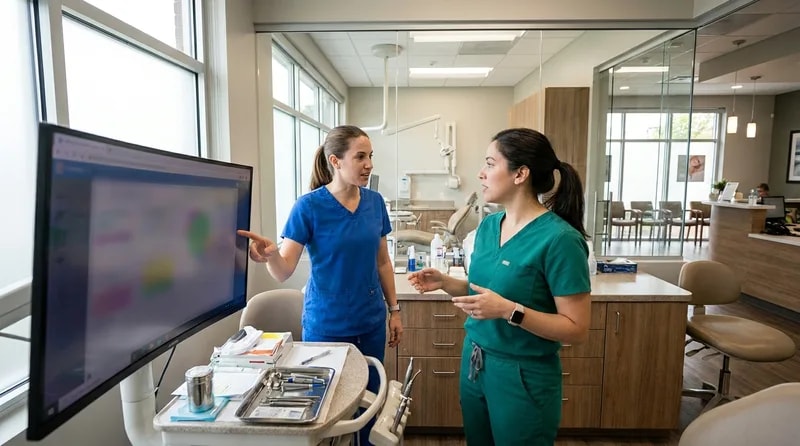
At 360 Dental that is endodontist Dr. Parham Mansouri, DDS, MS, who earned his DDS at UCLA and completed his endodontic residency at Saint Louis University. He has nearly 20 years in private practice, over 15 of them at 360 Dental. Founder Dr. Vachik Danoukh, DMD handles general and cosmetic treatment, and you can read about the practice and the team before you book.
The referral gap is where cases stall in practice. A general dentist diagnoses the problem, sends you elsewhere, and the second office has its own waiting list. For an infected tooth that delay is not neutral, which is the practical argument for keeping the specialist and the restoration in the same building.
- One set of records. No repeated intake forms or duplicate imaging at a second office.
- Coordinated restoration. The crown is planned alongside the treatment rather than after a handoff.
- Faster scheduling. Urgent cases do not wait for another practice to have availability.
- Continuity. Follow-up happens where the treatment was done.
How do you book root canal treatment in Van Nuys?
Call (818) 787-6400 or request an appointment online, and describe what you are experiencing. If there is swelling or fever, say so on the phone so the visit is treated as urgent rather than routine.
Before your appointment
Check each item you have sorted out in advance.
I have described my symptoms, including any swelling or fever.
I have mentioned any anxiety about the treatment.
I have brought a list of medications and medical conditions.
I have asked whether the restoration is the same visit or later.
I have agreed a signal to pause during treatment.
I have arranged the rest of my day around a longer appointment.
Your score: count your checks out of 6.
Planning your visit at 360 Dental in Van Nuys
- Where
6301 Van Nuys Blvd, Van Nuys, CA 91401, at the corner of Van Nuys Blvd and Victory Blvd, minutes off the 405 and 101.
- Hours
Monday to Thursday, 8:30 AM to 5:30 PM. Friday, 8:30 AM to 4:00 PM. Closed Saturday and Sunday.
- Languages
English, Spanish, and Armenian spoken at the front desk.
- On site
Root canal therapy with an in-house endodontist, crowns, emergency care, plus 3D CT and iTero scanning.
- Serving
Van Nuys, Sherman Oaks, North Hollywood, Encino, Panorama City, Valley Glen, Studio City, and Reseda.
- Ways to pay
All PPO dental plans, the 360-VIP membership club, and CareCredit, Sunbit, or Cherry financing.
One scheduling note. The office closes at 4:00 PM Friday and is shut at weekends, so a Thursday evening symptom is better raised Friday morning than left until Monday.
So, does a root canal hurt? The appointment is comfortable for most patients because the tooth is numbed first. What genuinely aches is the infected tooth beforehand, and that is what the treatment ends.
If you have been putting it off, the thing worth knowing is that waiting does not keep the option open. It narrows it.
Results may vary. Please consult with your dentist at 360 Dental for personalized treatment recommendations.
Get it diagnosed before it decides for you
360 Dental in Van Nuys performs root canal treatment on site with an endodontist, so diagnosis, treatment, and the crown are handled in one place.
Aching tooth, or told elsewhere that you need a root canal? Call (818) 787-6400 and describe the symptoms.
Common questions
Does a root canal hurt during the appointment?
For most patients, no. The tooth and surrounding tissue are fully numbed with local anesthetic before treatment begins, and your dentist checks that the area is numb before starting. Tell the team immediately if you feel any sensation.
Why do root canals have such a bad reputation?
The reputation was earned decades ago with older techniques and less effective anesthetic. It also confuses cause with treatment: patients arrive with a badly infected tooth, and the memory of that soreness attaches to the appointment that resolved it.
How long does the soreness last afterward?
Tenderness when biting on that tooth for a few days is typical and eases steadily. Your dentist will advise on over-the-counter relief. Soreness that increases after the third day, rather than settling, is worth a phone call.
Is it better to just have the tooth removed instead?
Sometimes, but keeping your natural tooth is usually preferable when it is restorable. Extraction leads to its own sequence: a gap, possible drifting of neighbors, and often an implant or bridge later. Your dentist should explain both paths.
How many visits does root canal treatment take?
Often one, sometimes two, depending on the tooth and whether infection needs settling first. Molars have more canals than front teeth and take longer. A crown or permanent filling to restore the tooth may be a separate appointment.
Does a root canal hurt more than a filling?
The sensation during treatment is broadly comparable, since both are done with the area numbed. Root canal treatment simply takes longer, so the appointment feels longer. Afterward, tenderness typically lasts a few days rather than hours.
What happens if I put it off?
Infection does not resolve on its own. It can spread into surrounding bone and soft tissue, and an abscess can develop quickly. Delaying often turns a treatable tooth into one that cannot be saved at all.
Who performs root canals at 360 Dental in Van Nuys?
Endodontist Dr. Parham Mansouri, DDS, MS, on site at 6301 Van Nuys Blvd, so treatment is not referred to another office. Call (818) 787-6400 to book. English, Spanish, and Armenian are spoken at the front desk.
Did this answer your question?
Written for general reading, not as advice about your own teeth. Nothing here replaces an examination: if something hurts, or has changed, book a visit and let a dentist look at it.
Read next
 13 min readWisdom Teeth Removal Recovery in Van Nuys: What to ExpectWisdom teeth removal recovery day by day: what to expect in the first 48 hours, what to eat, which symptoms need a call, and when you get back to normal.Read the article
 13 min readBotox for TMJ: How Jaw Tension Relief Works in Van NuysBotox for TMJ explained: which chewing muscles are treated, how long relief lasts, the off-label status, risks, and what belongs in a jaw tension plan.Read the article
Your first visit
One ticket covers it.
360 Dental · Admit one