
Orthodontics
Invisalign vs ClearCorrect: Real Cost and Result Differences
Published 9 min read
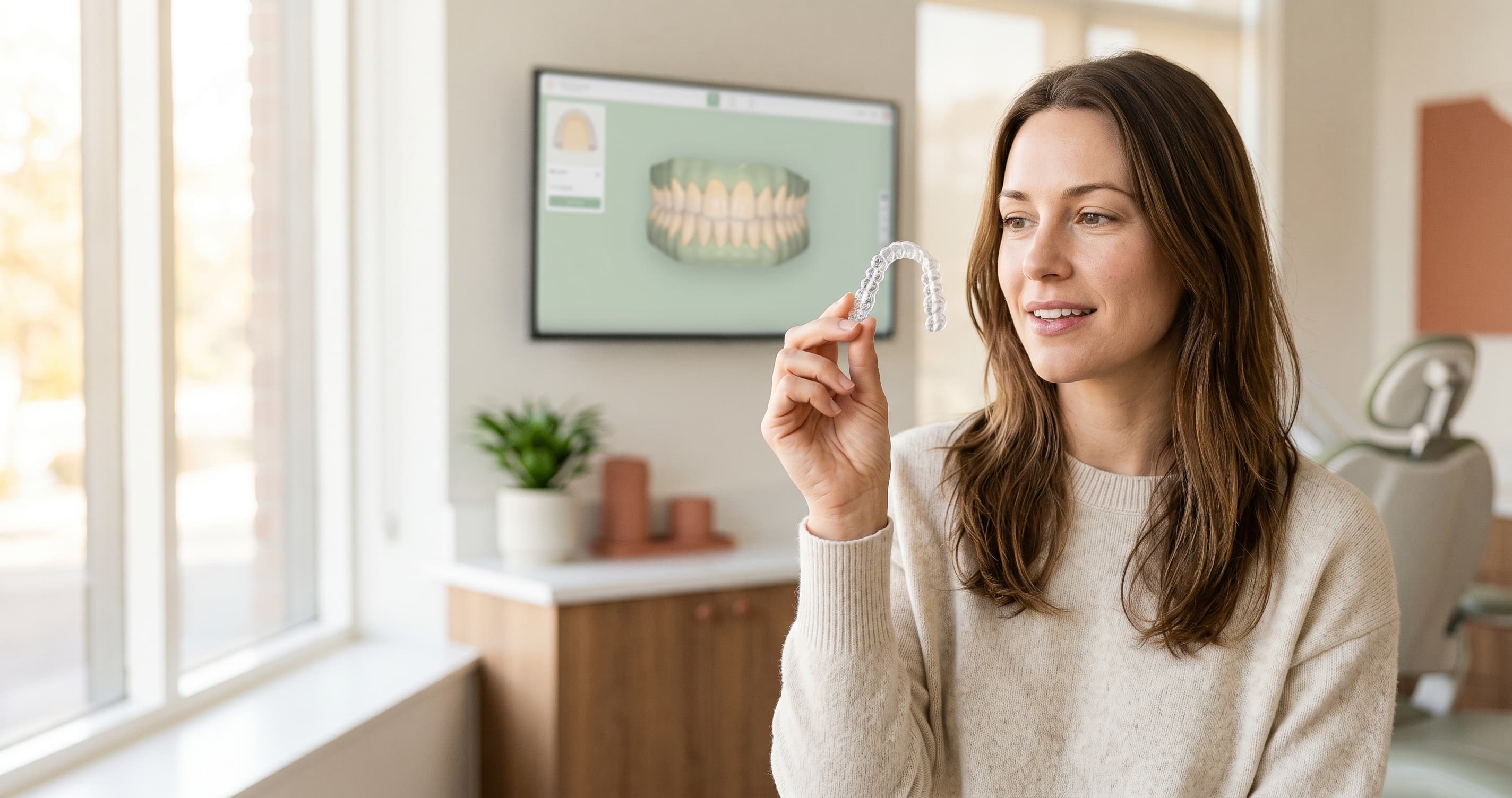
The Invisalign vs ClearCorrect question comes up more often than it used to, and for good reason. ClearCorrect (now owned by Straumann, one of the largest dental companies in the world) has invested heavily in material science and case capabilities over the past few years, narrowing the gap with Invisalign in ways that matter clinically. Both systems use custom-fabricated clear trays to move teeth. Both require a trained dentist to plan and monitor treatment. And both produce good results for the right cases.
But they're not identical. The differences in material, treatment planning software, case complexity range, cost structure, and provider availability affect which one is the better fit for a given patient. Dr. Esther Jeong at Willow Family Dentistry in Wylie, TX evaluates aligner systems based on what they can deliver for each patient's specific bite, not brand loyalty. This guide compares the two systems on every factor that matters in 2026.
Whichever system fits your case, treatment starts with a consultation. Our clear aligners in Wylie page explains what that first visit involves.
Invisalign leads on
Complex cases, feature range, and treatment data
ClearCorrect leads on
Price, for mild-to-moderate cases it can treat equally well
How Do Invisalign and ClearCorrect Compare Overall?
Both Invisalign and ClearCorrect are FDA-cleared Class II medical devices that use a series of custom thermoplastic trays to progressively move teeth. The fundamental mechanism is the same: each tray applies light, continuous force to shift teeth approximately 0.25mm per stage. The differences show up in the details.
The American Association of Orthodontists recognizes both Invisalign and ClearCorrect as effective clear aligner systems for appropriate cases. The choice between them should be driven by clinical fit, not marketing.
How Does Tray Material Differ Between the Two?
Material is where Invisalign has invested the most R&D dollars, and it's one of the most tangible differences patients notice.
SmartTrack, Invisalign
Multi-layer polyurethane, introduced in 2013. Slightly more flexible on insertion and removal.
ClearQuartz, ClearCorrect
Tri-layer construction, newer. Stiffer, built to hold its shape across a 14-day cycle.
Invisalign's SmartTrack
Invisalign's SmartTrack material, introduced in 2013, is a multi-layer polyurethane that applies more consistent force across the tray's lifespan. According to Align Technology, SmartTrack delivers 75% more force consistency compared to single-layer materials, which translates to more predictable tooth movement per tray.
ClearCorrect's ClearQuartz
ClearCorrect's ClearQuartz material, introduced more recently, is a tri-layer construction that's significantly stiffer than their previous single-layer trays. It's designed to maintain its shape better over the 14-day wear period and resist the deformation that causes single-layer trays to lose effectiveness toward the end of their cycle. Straumann claims ClearQuartz is comparable to SmartTrack in sustained force delivery, though independent head-to-head data is limited.
What Patients Actually Notice
What patients notice: SmartTrack trays tend to feel slightly more flexible when inserting and removing, which many patients find more comfortable. ClearQuartz trays feel slightly firmer. Both become virtually invisible once seated. Neither material stains significantly more than the other with proper care (rinse after removal, brush before reinserting, avoid eating or drinking anything other than water while wearing trays).
Which System Handles More Complex Cases?
This is where the Invisalign vs ClearCorrect gap is most meaningful clinically. Invisalign has a broader toolkit for complex movements, and 17 million treated cases means their treatment planning algorithm has more data to draw from.
Invisalign's Wider Toolkit
Invisalign's SmartForce attachments (tooth-colored bumps bonded to teeth for additional grip) are available in more shapes and configurations than ClearCorrect's attachment options. Invisalign's Precision Wings handle Class II bite correction (overbite) without elastics in many cases. Invisalign's mandibular advancement feature treats mild-to-moderate mandibular retrusion within the aligner itself. And ClinCheck's AI-assisted treatment planning benefits from the largest dataset in the clear aligner industry.
Where ClearCorrect Has Caught Up
ClearCorrect has closed the gap substantially for mild-to-moderate cases. Their attachment system handles rotations, extrusions, and root control effectively for cases within their range. For moderate crowding, spacing, and mild bite correction, the clinical outcomes between the two systems are comparable when managed by an experienced provider.
Where the Gap Still Matters
Where the gap still matters: severe crowding requiring extraction, complex multi-plane movements, significant bite corrections requiring mandibular advancement, and cases with multiple teeth needing rotation beyond 15-20 degrees. For these cases, Invisalign's broader feature set provides more options. That doesn't mean ClearCorrect can't treat them, but the treatment planning may require more workarounds and the outcomes may be less predictable.
Cases where Invisalign's toolkit pulls ahead
•Severe crowding requiring extraction
•Complex multi-plane movements
•Significant bite corrections requiring mandibular advancement
•Multiple teeth needing rotation beyond 15-20 degrees
Related: Wondering what results aligners realistically achieve? → Invisalign Before and After: What Real Results Look Like
Whether your case is "mild-to-moderate" or "complex" decides the whole comparison, and only a scan can tell you. Book an aligner consultation with Dr. Jeong →
How Do Costs Compare Between Invisalign and ClearCorrect?
ClearCorrect typically costs less than Invisalign, and the difference is meaningful. ClearCorrect treatments range from $2,500-$5,500 while Invisalign ranges from $3,500-$7,500 depending on case complexity and geographic market. The cost difference comes from lower lab fees (ClearCorrect charges dentists less per case than Align Technology), and some of that savings gets passed through to patients.
Invisalign
$3,500-$7,500
ClearCorrect
$2,500-$5,500
Both Systems Are Tiered by Case Size
Both systems offer tiered pricing. Invisalign has Express (up to 7 trays), Lite (up to 14 trays), Moderate (up to 20 trays), and Comprehensive (unlimited trays with refinement included). ClearCorrect offers One (up to 6 trays per arch), Two (up to 12), Three (up to 24), and Unlimited (unlimited trays with refinement). The tiers map to case complexity: simpler cases use fewer trays and cost less.
Insurance, HSA, and FSA
Insurance coverage is the same for both. Most dental plans with orthodontic benefits cover clear aligners the same way they cover braces: a lifetime orthodontic maximum (typically $1,000-$2,500) applied regardless of which aligner brand you choose. The ADA classifies both as orthodontic treatment, so the insurance code (D8040 for limited treatment, D8090 for comprehensive) is the same. HSA and FSA funds can be used for either system.
Related: Full aligner pricing breakdown for Texas. → Clear Aligner Cost Texas: Real Numbers for 2026
Your tier, your tray count, and your out-of-pocket number all come from one scan. Get your case scanned and priced →
Does the Provider Matter More Than the Brand?
Yes. This is the most important section of this article. The provider's skill, experience, and treatment planning ability matter more than whether the trays are stamped Invisalign or ClearCorrect. An experienced dentist with either system will outperform an inexperienced dentist with the "better" brand.
An experienced dentist with either system will outperform an inexperienced dentist with the "better" brand.
The Dentist Designs the Plan, Not the Software
According to the AAO, the treatment plan is designed by the dentist, not the aligner company. The software generates a proposed movement sequence, but the dentist reviews it, adjusts it, adds or removes attachments, changes staging, and modifies the plan based on clinical judgment. A dentist who understands biomechanics, force systems, and anchorage can get excellent results from either platform. A dentist who accepts the software's default plan without modification may get suboptimal results from either one.
How Dr. Jeong Decides
Dr. Jeong evaluates each case individually and recommends the aligner system that best matches the clinical requirements. For moderate-to-complex cases where SmartForce attachments and Precision Wings provide a measurable advantage, she'll recommend Invisalign. For straightforward mild-to-moderate cases where both systems perform equivalently, the cost difference may favor ClearCorrect. The recommendation is always case-driven.
What Should You Ask at Your Consultation?
Whether you're leaning toward Invisalign or ClearCorrect, the questions that matter at your consultation are the same. They're about your case, not the brand.
✓What's the projected treatment time for my specific case?
✓How many trays will I need, and is refinement likely?
✓What attachments will be required, and where?
✓What's the total cost including refinement if needed?
✓What happens if my teeth aren't tracking midway through?
✓Why are you recommending this system over the alternative for my case?
A dentist who can answer all of these clearly, with imaging data to support the recommendation, is the provider you want regardless of which aligner brand they prefer. Dr. Jeong uses iCAT 3D imaging alongside the digital aligner scan to evaluate root positions, bone density, and jaw anatomy before finalizing a treatment plan. That level of diagnostic data is what separates a carefully planned case from a default-accept-the-software case.
Related: How long will aligner treatment actually take? → How Long Does Invisalign Take? Timeline by Case Type
If Missing Teeth Are the Real Problem
Invisalign and ClearCorrect both work by moving teeth you still have, neither is a solution for teeth that are already missing. If tooth loss (not misalignment) is the issue you're actually facing, the comparison points are different.
Related: Weighing tooth-replacement options instead? → Dental Implants vs Dentures in Texas: Cost, Comfort, Value
The Bottom Line on Invisalign vs ClearCorrect
The Invisalign vs ClearCorrect comparison in 2026 isn't a clear-cut winner-take-all. Invisalign has the broader toolkit, the larger dataset, and the edge in complex cases. ClearCorrect offers comparable results for mild-to-moderate cases at a lower price point. Both work. Both are legitimate. The right choice depends on your teeth, your budget, and the dentist managing your treatment.
If you're ready to find out which system fits your case, schedule a consultation at Willow Family Dentistry. Dr. Jeong will scan your teeth, evaluate your bite, and recommend the path that gives you the best outcome.
Find the Right Aligner for Your Smile
Dr. Jeong compares Invisalign and ClearCorrect for your specific case, using a digital scan and treatment preview. One consultation, a clear recommendation, and honest pricing before you commit.
Questions about aligner options? Call (972) 881-0715
Common questions
Is ClearCorrect as good as Invisalign?
For mild-to-moderate cases, ClearCorrect produces comparable results at a lower price point. For complex cases involving severe crowding, significant bite correction, or multi-plane movements, Invisalign's broader feature set provides more options.
Is ClearCorrect cheaper than Invisalign?
Yes. ClearCorrect typically costs $2,500-$5,500 vs Invisalign's $3,500-$7,500. The difference comes from lower lab fees. Both offer tiered pricing based on case complexity with unlimited refinement options.
Does insurance cover both Invisalign and ClearCorrect?
Yes. Both are classified as orthodontic treatment under the same insurance codes. Your lifetime ortho maximum applies regardless of brand. HSA and FSA funds work for either system.
Which aligner system is faster?
Treatment times are comparable for similar cases. Invisalign may allow 7-day tray changes for fast responders while ClearCorrect standardizes at 14 days. The case complexity determines timeline more than the brand.
Can my dentist use both systems?
Yes. Many dentists including Dr. Jeong are trained in both and recommend the system that best fits each patient's clinical needs. The choice is case-driven, not brand-driven.
Which aligner material is better?
Invisalign's SmartTrack is the industry benchmark for force consistency. ClearCorrect's newer ClearQuartz tri-layer material has narrowed the gap. Both maintain shape throughout their wear cycle and are virtually invisible.
Do clear aligners work as well as braces?
For mild-to-moderate cases, clear aligners produce comparable results to braces. For severe crowding or complex skeletal issues, braces remain more effective. Dr. Jeong evaluates which approach fits your specific case.
Did this answer your question?
Written for general reading, not as advice about your own teeth. Nothing here replaces an examination: if something hurts, or has changed, book a visit and let a dentist look at it.
Read next
 10 min readBraces Care Tips for Teens Heading Back to School NowBraces care tips for teens: what to pack in a locker kit, cafeteria foods to skip, sports and instruments, a poking wire in class, and picture day.Read the article
 12 min readClear Aligners Consultation Near Me: What to ExpectBooking a clear aligners consultation near me?Read the article
 11 min readInvisalign Attachments and Refinements: What to ExpectInvisalign attachments and refinements explained: what they are, why they are needed, what they feel like, and how they fit into your treatment.Read the article
Your first visit
One ticket covers it.
360 Dental · Admit one