
Periodontal Care
Laser Gum Treatment in Van Nuys: A Gentler Alternative
Published 13 min read
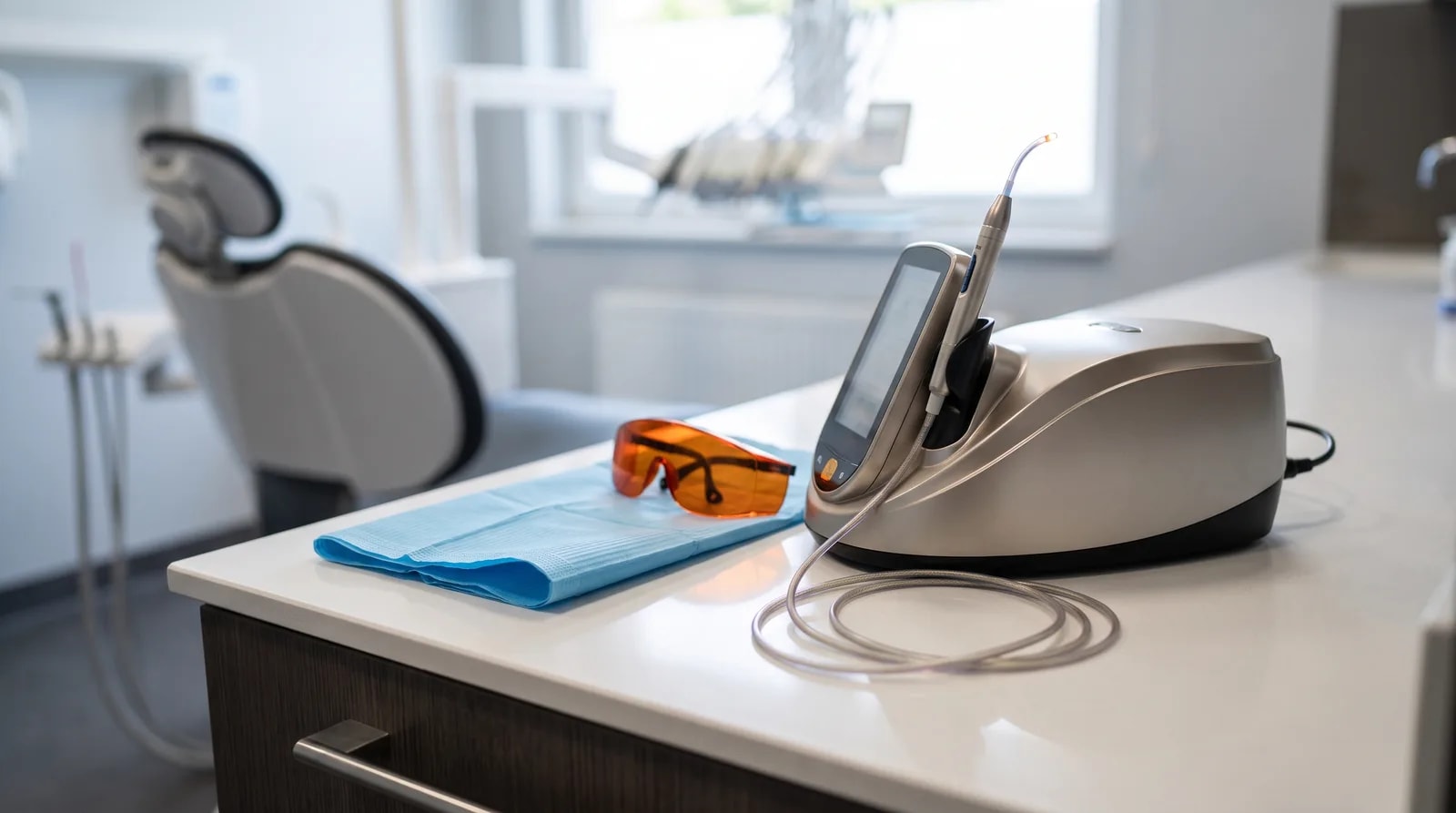
Most people hear about laser gum treatment right after a dentist reads out pocket depths that are worse than expected. It arrives as a question you were not prepared for, usually framed as gentler, and usually without much explanation of what it actually replaces. Gum care sits inside preventive care at 360 Dental in Van Nuys.
The short version is worth stating up front, because it is not what most marketing implies. A laser is a tool, not a treatment plan. In most cases it works alongside conventional instruments rather than instead of them.
Below is what the appointment involves, what the comfort difference actually amounts to, who it suits, and the cases where conventional scaling on its own is the sensible answer.
What is laser gum treatment, and how does it work?
It uses focused light energy to remove inflamed tissue and reduce bacteria in the space between tooth and gum. The energy is absorbed selectively by diseased tissue, which is what allows a clinician to work below the gum line with less bleeding than instruments alone produce.
The selectivity is the interesting part. Healthy tissue and diseased tissue absorb the energy differently, so the tool can be aimed at what needs removing. That is the mechanism behind most of the practical differences patients notice.
- Removes diseased tissue from the pocket lining without a blade.
- Reduces bacteria in the treated area at the time of treatment.
- Limits bleeding during the procedure, which improves visibility for the clinician.
- Does not remove hardened deposits from the root surface, which still needs instruments.
That last point matters more than the first three. Calculus bonded to a root surface is a mechanical problem requiring a mechanical solution. The American Academy of Periodontology describes scaling and root planing as the foundational non-surgical treatment, and a laser does not change that.
How does laser gum treatment differ from traditional deep cleaning?
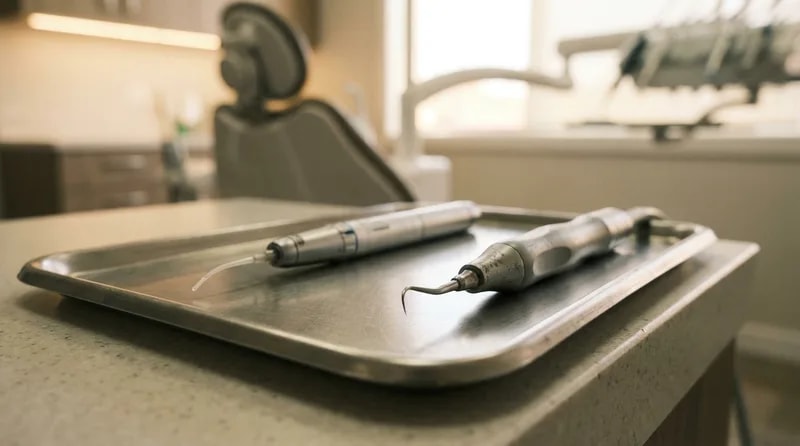
Traditional deep cleaning removes plaque and hardened deposits from root surfaces using hand and ultrasonic instruments. A laser addresses the inflamed tissue lining the pocket and reduces bacteria. They target different parts of the same problem, which is why they are frequently combined.
| Scaling and root planing | Laser therapy | |
|---|---|---|
| Main target | Deposits on the root surface | Diseased tissue lining the pocket |
| Removes calculus | Yes, this is its core function | No, not its mechanism |
| Bleeding during treatment | More typical | Generally less |
| Anesthetic | Usually used | Usually still used |
| Evidence base | Long established as standard non-surgical care | Growing, varies by device and protocol |
| Typical role | The foundation of treatment | An addition for selected sites |
| Insurance coverage | Widely coded and commonly covered | Varies considerably by plan |
Read that evidence row carefully, because it is the honest state of things. Conventional scaling has decades of research behind it. Laser protocols vary between devices and practices, so the research is less uniform. That is not an argument against it. It is a reason to ask specific questions.
In practice, combined treatment looks like this. Instruments do the mechanical work first, clearing deposits from the root surfaces across a quadrant. The laser then treats the pockets that measured deepest. You are not picking between two products; you are deciding whether a second step gets added at specific sites. That framing makes the coverage question much easier, because you can ask what the addition is for.
Is it actually more comfortable than conventional cleaning?
Many patients report it that way, mainly because of reduced bleeding and less mechanical scraping sensation. Local anesthetic is still typically used. Individual experience varies quite a lot, and comfort should not be the only reason a treatment is chosen.
Comfort is still a legitimate factor, though, and worth taking seriously rather than dismissing as a soft preference. 36% of Americans have dental anxiety and 12% have extreme dental fear, according to BMC Oral Health, 2024. For someone who has avoided treatment for years, a more tolerable appointment is the difference between getting care and continuing to avoid it.
What patients most often mention
- Less bleeding during the visit
- Less scraping sensation
- Shorter settling period after
- Quieter than ultrasonic instruments
- Still needs local anesthetic
- Varies by how deep the site is
Set expectations honestly with yourself, too. Gentler than conventional treatment is not the same as feeling nothing, and any provider who promises the latter is overselling.
It helps to be specific about what the comfort difference actually consists of, because "gentler" on its own means very little. The scraping sensation of an instrument working along a root surface is what most people remember and dislike. Reduced bleeding also means less rinsing and suction during the visit, which shortens how long your mouth stays open. Small things, but they add up across an hour.
What happens during the appointment?
Measurements are reviewed, the area is numbed, deposits are removed with instruments, then the laser is used on the selected sites. Treatment is often divided by quadrant across more than one visit. You leave with aftercare instructions specific to the sites treated.
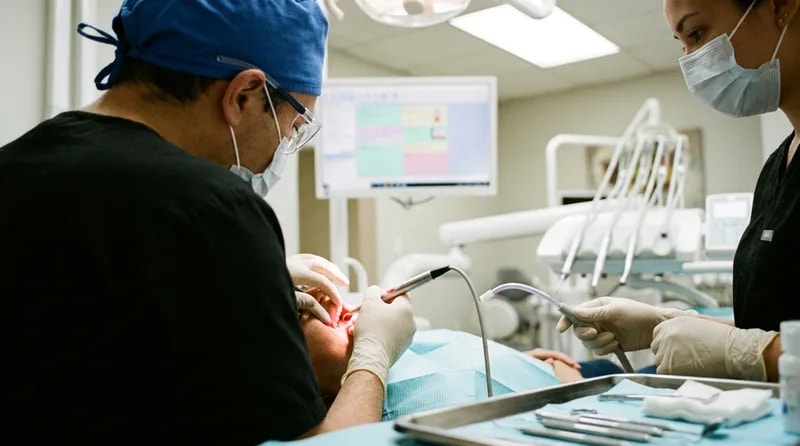
That final re-measurement is the part to insist on. Without it, nobody knows whether the treatment worked, and you are relying on how your gums feel, which is exactly the unreliable signal that let the disease progress in the first place.
What does recovery look like afterward?
Most people eat normally within a day or two, with tenderness and mild sensitivity easing over the following week. Some gum shrinkage as inflammation resolves is expected and can make teeth feel slightly longer. Your dentist gives you site-specific guidance.
- Day 1Immediately after
Numbness wears off over a few hours. Stick to soft, cool foods and avoid the treated sites when brushing. Some tenderness when biting is normal at this point.
- Days 2 to 7Settling
Tenderness fades and normal eating resumes for most people. Gentle brushing of the treated area typically restarts as directed, along with any rinse your dentist recommended.
- Weeks 2 to 6Tissue response
Inflammation reduces and tissue tightens against the tooth. Gums may look slightly shrunken compared with before, which is a sign of resolving swelling rather than a problem.
- The follow-up visitRe-measurement
Pocket depths and bleeding points are recorded again and compared with your pre-treatment chart. This is where you find out what the treatment achieved.
Sensitivity to cold at the treated sites is common for a few weeks and usually settles. Mention it at the follow-up rather than assuming it is permanent, because it often is not.
Know the difference between settling and going wrong, though. Tenderness that eases day by day is the normal pattern. Swelling that grows, a bad taste that appears several days later, or tenderness that climbs after the first few days are all reasons to call rather than wait for the scheduled follow-up. Dental abscesses can spread to other parts of the body within 48 hours if untreated, according to JADA, so swelling with fever is a same-day call.
| Ask your dentist | Why it matters |
|---|---|
| Which sites would be lasered, and why those? | A site-by-site answer shows the plan came from your measurements. |
| What if we start conventionally and re-measure? | Shows whether the addition is needed now or only if sites fail to respond. |
| When will pockets be measured again? | Without re-measurement nobody knows whether it worked. |
When is traditional scaling the better choice?
Often. For early gum inflammation, shallow pockets, or a first course of treatment, conventional scaling and root planing is well established, widely covered by insurance, and frequently sufficient on its own. Adding a laser is not automatically an improvement.
- Early inflammation with shallow pockets. Conventional cleaning plus better home care often handles this entirely.
- A first course of treatment. Establish how your tissue responds to the standard approach before adding to it.
- Coverage is the deciding factor. If a plan covers scaling and not laser therapy, starting with covered care is sensible rather than second best.
- Advanced attachment loss. Substantial bone loss may need a surgical approach, which is a different conversation from either option here.
Coverage deserves a straight answer too. Conventional scaling has procedure codes most PPO plans recognize, while laser therapy is covered far less consistently. Ask for a written estimate for both approaches before committing to either.
Also worth remembering that neither approach substitutes for what happens between visits. NIH patient information on gum disease puts daily cleaning and regular professional care at the center of managing the condition, and no in-office tool changes that.
Realistic goals, and one that is not
- Less bleeding on probing
- Shallower pocket readings
- Slower progression
- Easier home cleaning
- Not regrown bone
- Not regrown gum tissue
Who is a good candidate for this approach?
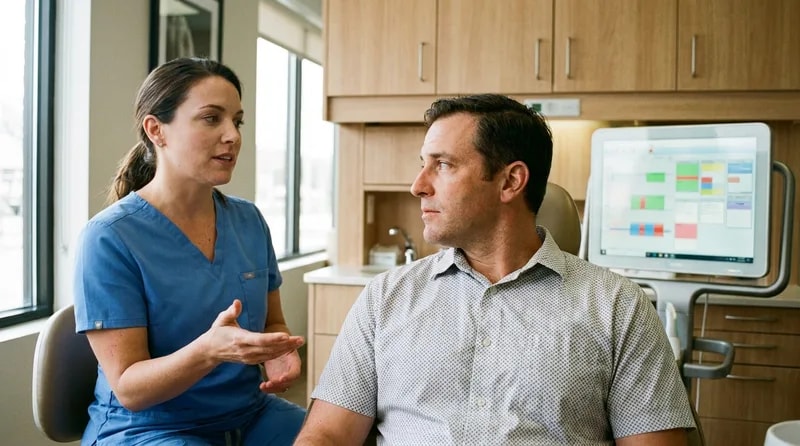
Typically patients with moderate pockets that have not responded fully to conventional cleaning, those who bleed heavily during treatment, and people whose anxiety has kept them from completing care. Candidacy is decided from measurements, not from preference alone.
Sites that did not respond
The clearest case
You completed conventional scaling, came back for re-measurement, and specific pockets are still deep and still bleeding. Those individual sites are where added treatment has the most obvious rationale.
Skip: Treating the whole mouth when only three sites are involved.
Heavy bleeding during treatment
A practical case
Some patients bleed enough that a clinician cannot see the working area properly. Reduced bleeding improves visibility, which affects how thoroughly the site can be cleaned.
Skip: Assuming this applies to you without being told it does.
Treatment avoided for years
The access case
If previous appointments were difficult enough that you stopped going, a more tolerable option that gets you through a full course of treatment is worth real weight in the decision.
Skip: Choosing on comfort alone if your dentist advises otherwise.
Crowding belongs in this conversation as well, because it is the one risk factor you can change. Straight teeth are easier to clean, reducing the risk of cavities and gum disease by up to 30% according to the ADA. If floss cannot reach a surface, no in-office treatment keeps that site healthy long term.
Two conditions change the calculation. Smoking reduces blood flow to the gums, which affects healing after any periodontal treatment. Diabetes works in both directions. Neither rules anything out, but both belong in the plan rather than mentioned afterward.
Ask the specific question: which sites, and why those. A recommendation that covers your entire mouth uniformly deserves more explanation than one that names four pockets.
What are the most common myths about gum lasers?
Three assumptions cause the most confusion: that a laser replaces cleaning entirely, that newer automatically means more effective, and that it regrows lost gum tissue. Each one leads to expectations the treatment was never designed to meet.
- Myth
A laser replaces the deep cleaning entirely.
- Reality
Hardened deposits on the root surface still need instruments. The laser addresses tissue and bacteria, not calculus.
- Myth
Newer technology means better results for everyone.
- Reality
Conventional scaling has the longer evidence record. The right question is which sites benefit, not which tool is newer.
- Myth
Laser treatment regrows the gum I have lost.
- Reality
Treatment stabilizes and reduces inflammation. Attachment that has been lost does not return on its own.
A fourth belief is quieter but just as costly: that having the treatment means the work is finished. Periodontal disease is managed rather than closed out, so maintenance visits at the interval your dentist sets are what hold the result. Patients who complete treatment and then stop attending tend to be the ones back in the same chair a few years later, with deeper pockets than before.
Get measurements before you get a recommendation
An assessment at 360 Dental in Van Nuys records pocket depths and bone levels first, with gum disease treatment including laser therapy available on site.
Where can you get laser gum treatment in Van Nuys?
360 Dental offers laser gum therapy alongside deep cleanings and periodontal maintenance at 6301 Van Nuys Blvd. Book an assessment first so measurements come before recommendations. Call (818) 787-6400 or request an appointment online.
Planning your visit at 360 Dental in Van Nuys
- Where
6301 Van Nuys Blvd, Van Nuys, CA 91401, at the corner of Van Nuys Blvd and Victory Blvd, minutes off the 405 and 101.
- Hours
Monday to Thursday, 8:30 AM to 5:30 PM. Friday, 8:30 AM to 4:00 PM. Closed Saturday and Sunday.
- Languages
English, Spanish, and Armenian spoken at the front desk.
- On site
Laser gum therapy, deep cleaning, periodontal maintenance, gum surgery, plus 3D CT and iTero digital scanning.
- Serving
Van Nuys, Sherman Oaks, North Hollywood, Encino, Panorama City, Valley Glen, Studio City, and Reseda.
- Ways to pay
All PPO dental plans accepted, plus the 360-VIP membership club and CareCredit, Sunbit, and Cherry financing.
Two notes when you book. Ask for your pocket depth chart, and ask whether previous records can be transferred, because comparison over time beats any single set of numbers. Americans who visit a dentist regularly are 60% less likely to lose teeth, according to the Journal of Dental Research.
Related: Knowing what periodontal care covers before you need it makes the treatment conversation shorter. Periodontics at 360 Dental in Van Nuys →
The useful way to think about laser gum treatment is as a tool for selected sites rather than a category upgrade for your whole mouth. Regular dental visits can catch 80% of oral health issues before they become serious, according to the ADA, and that is still the thing doing most of the work.
Book an assessment, get the measurements written down, and ask which specific pockets a laser would address and why. A recommendation that can answer that is one you can trust.
Results may vary. Please consult with your dentist at 360 Dental for personalized treatment recommendations.
Start with measurements, not a treatment name
An assessment at 360 Dental in Van Nuys records pocket depths, bleeding points, and bone levels, then matches the approach to what those numbers show.
Been told you need a deep cleaning and want to understand the options? Call (818) 787-6400 and the team will walk you through what applies to your case.
Common questions
Is laser gum treatment better than a deep cleaning?
Not better in every case, and often used together. The laser addresses diseased tissue and bacteria, while instruments remove hardened deposits from the root surface. Your dentist decides based on pocket depths and how your tissue has responded before.
Does laser gum treatment cause discomfort?
Most patients describe it as more comfortable than expected, and local anesthetic is still typically used. Sensation varies between people and between sites. Tell your dentist during treatment rather than afterward if anything feels sharp.
How many visits does laser gum treatment take?
It depends on how many areas need attention, since treatment is often split by quadrant across more than one appointment. Your dentist maps this out from your gum measurements before starting, so you know the plan in advance.
Will my gums grow back after laser treatment?
Treatment aims to reduce inflammation and stabilize what remains rather than restore lost attachment. Tissue that has receded does not regrow on its own. Realistic goals are less bleeding, shallower pockets, and slower progression.
Is laser gum treatment covered by insurance?
Coverage varies significantly between plans and procedure codes. 360 Dental accepts all PPO dental plans and can check your specific benefits before treatment. Call (818) 787-6400 and ask for an estimate in writing first.
How long does recovery from laser gum treatment take?
Most people return to normal eating within a day or two, with tenderness settling over the following week. Your dentist gives you site-specific instructions. Follow those rather than general timelines you read online.
Can laser gum treatment replace surgery?
In some moderate cases it reduces the need for surgical intervention, but advanced attachment loss can still require a surgical approach. That determination comes from measurements and imaging, not from a preference for one method.
Where can I get laser gum treatment in Van Nuys?
360 Dental at 6301 Van Nuys Blvd offers laser gum therapy alongside deep cleanings and periodontal maintenance on site. Call (818) 787-6400 to book an assessment. English, Spanish, and Armenian are spoken at the front desk.
Did this answer your question?
Written for general reading, not as advice about your own teeth. Nothing here replaces an examination: if something hurts, or has changed, book a visit and let a dentist look at it.
Your first visit
One ticket covers it.
360 Dental · Admit one