
Oral Health Tips
Dental Implants vs Dentures Cost in Texas: The 10-Year Math
Published 8 min read
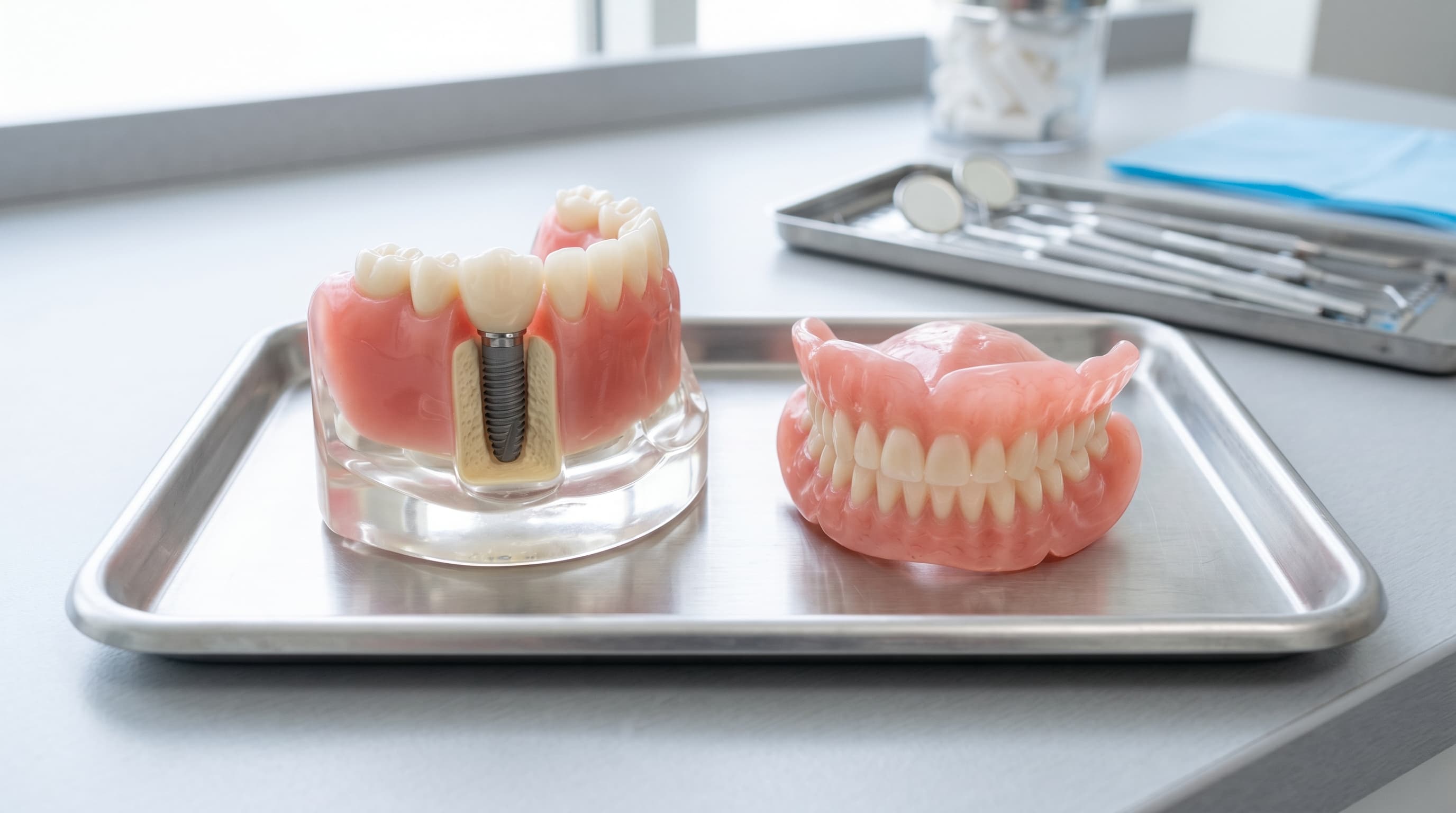
The dental implants vs dentures cost question faces thousands of Texas patients every year, and it is one of the biggest financial and quality-of-life choices a dental patient makes. In Texas, the cost landscape, insurance environment, and financing options shape the decision as much as the clinical picture does.
Both are offered here, and the right answer depends on how long you plan to keep the restoration. See dental implants in Wylie.
Dr. Esther Jeong at Willow Family Dentistry in Wylie, TX presents both options with transparent pricing at every consultation. She places implants in-house (no referral to an outside surgeon needed), fabricates dentures on-site, and offers both insurance coordination and financing to make either option accessible. This comparison uses real Texas pricing, not national averages that may not reflect what you'll actually pay.
What Do Dental Implants and Dentures Actually Cost in Texas?
DFW dental pricing runs 5-15% below coastal city averages (New York, San Francisco, Los Angeles) due to lower overhead costs, but Texas prices have been rising faster than the national average since 2023 as population growth has increased demand. The pricing above reflects current Wylie/Plano/Allen/McKinney market rates. According to the ADA Health Policy Institute, Texas dental spending per capita has increased approximately 8% over the last two years, outpacing the national 5% increase.
How Do Implants and Dentures Compare for Comfort and Function?
This is where the numbers tell only part of the story. Implants are fixed to the jaw and behave like natural teeth, while dentures rest on the gums and shift as the ridge changes shape. The daily experience of living with each one is dramatically different, and it affects diet, speech, and confidence in ways cost alone does not capture.
The chewing efficiency difference is the most functionally significant. Conventional dentures restore only 25-40% of natural biting force. Patients with dentures avoid steak, raw vegetables, apples, corn on the cob, and many nutritious foods that require significant chewing force. According to the Mayo Clinic, this dietary restriction contributes to nutritional decline in denture wearers, particularly seniors who need protein and fiber most. Implants restore 90-95% of natural function with no dietary restrictions.
Bone preservation is the difference that compounds over time. Without tooth roots or implants stimulating the jawbone, the bone resorbs (shrinks). According to clinical research, denture wearers lose approximately 25% of their ridge height in the first year after tooth loss and continue losing bone progressively. This is why dentures that fit well initially become loose over 3-5 years and require relining. Implants halt this resorption by providing the mechanical stimulus bone needs to maintain density.
Related: Full implant pricing with line items. → Dental Implant Cost in Wylie, TX: 2026 Line-Item Breakdown
What's the 10-Year Cost Comparison?
Looked at over a decade, the dental implants vs dentures cost gap narrows and then reverses. Dentures are remade on a cycle of roughly five to seven years, and each remake carries the full fee again, while a well-maintained implant is placed once. The yearly cost of ownership, rather than the sticker price, is the number that separates them.
The upfront cost of implants is higher. But dental decisions are long-term investments, and the 10-year total cost changes the picture.
A single implant at $4,000 that lasts 20+ years costs $200/year. A denture at $2,500 that needs $1,000 in relines and $2,500 in replacement over 10 years costs $600/year. The implant costs less per year while providing dramatically better function and comfort. The gap widens further over 15 and 20 years because the implant continues at $0 additional cost while denture maintenance compounds.
For full-arch comparison, implant-supported dentures ($8,000-$25,000) have higher upfront cost than conventional dentures ($1,000-$3,500) but eliminate relines, reduce replacement frequency, and prevent the bone loss that makes future denture fit progressively worse.
What Does Texas Dental Insurance Typically Cover?
Texas employer-sponsored dental plans typically follow national PPO structures, with some Texas-specific patterns worth understanding. Most plans treat dentures as a covered basic or major restorative benefit while classifying implants as elective, which is the single biggest reason the two options feel so far apart at the front desk.
Most Texas PPO plans cover dentures at 50% after deductible, classifying them as "major" dental work. The annual maximum ($1,000-$2,500 on most plans) limits the practical benefit: a $2,500 denture on a plan with $1,500 annual max and 50% coverage pays only $750 toward the denture. According to the ADA, annual maximums on Texas dental plans have not kept pace with dental cost increases since the 1980s.
Implant coverage in Texas has improved significantly since 2020. Most current PPO plans cover the implant crown at 50% (the same as any other crown). Some cover a portion of the surgical placement. A growing number of plans classify the full implant (post + abutment + crown) as a covered benefit. Dr. Jeong's team verifies your specific coverage before treatment and presents the out-of-pocket cost after insurance has been applied.
Texas Medicaid (STAR and STAR+PLUS) covers dentures for qualifying adults but does not cover implants. CHIP (Children's Health Insurance Program) covers medically necessary dental treatment for children but implants are rarely applicable in pediatric cases.
HSA and FSA accounts cover both implants and dentures with pre-tax dollars. For Texas patients with no state income tax, the federal tax savings from using HSA/FSA funds represents 22-37% savings on the out-of-pocket cost (depending on federal tax bracket). Dr. Jeong's team helps patients plan treatment timing to maximize benefit year utilization.
Related: Maximize pre-tax dental savings. → HSA/FSA for Dental Work Before Year-End
How Should Texas Patients Decide?
Dr. Jeong's framework matches the option to the patient, not the other way around. The questions that matter most are how much healthy bone remains, how long you expect to keep the restoration, and whether a removable appliance fits the way you actually live. The answers point clearly in one direction more often than patients expect.
Choose implants if you want permanent, maintenance-free teeth that function like natural ones, your health allows minor oral surgery, and the iCAT scan confirms adequate bone (or bone grafting is feasible). The higher upfront investment pays for itself within 5-8 years when compared to denture maintenance costs and delivers superior comfort and function from day one.
Choose dentures if you need an affordable non-surgical solution, have medical conditions that make surgery inadvisable, are replacing many teeth across the arch simultaneously, or prefer the lower initial investment. Modern dentures are more comfortable and natural-looking than previous generations, and they remain a valid choice for patients who understand the trade-offs.
Choose implant-supported dentures if you've struggled with loose conventional dentures, want the stability of implants at a lower cost than individual implant crowns for every tooth, and are a surgical candidate. This is the option that produces the highest patient satisfaction scores in research because it solves the primary denture complaint (instability) while costing significantly less than a full arch of individual implants.
One more factor worth flagging before your consultation: smoking status. Smoking slows healing after implant surgery and is linked to higher implant failure rates, so patients who smoke should discuss a cessation plan with Dr. Jeong as part of the decision, not as an afterthought once treatment has started.
Related: Replacement options by age and health status. → Tooth Replacement Options for Seniors
Get Real Numbers for Your Situation
Dr. Jeong presents both options with your insurance verification, iCAT bone evaluation, and transparent pricing in one consultation. No obligation. No pressure. Real numbers so you can decide.
Dental implants vs dentures in Texas comes down to upfront cost vs long-term value, surgical willingness vs non-surgical preference, and the daily comfort you expect from your teeth. The 10-year cost comparison often favors implants. The functional comparison always does. But dentures remain the right choice for patients whose medical status, financial situation, or personal preference points in that direction. At Willow Family Dentistry, Dr. Jeong presents both with transparent Texas-market pricing, your insurance benefits already verified, and the honest assessment of which option serves your specific teeth, health, and goals.
Both Options. Transparent Pricing. One Consultation.
Dr. Jeong places implants in-house and fabricates dentures on-site. Insurance verification, iCAT evaluation, and pricing presented together so you leave with the complete picture.
Questions about implants or dentures?
Common questions
How much do dental implants cost in Texas?
Single implant in DFW: $3,100-$5,300 (post + abutment + crown). Implant-supported denture: $8,000-$25,000 per arch. DFW pricing runs 5-15% below coastal city averages. Dr. Jeong provides exact pricing at consultation.
How much do dentures cost in Texas?
Complete denture in DFW: $1,000-$3,500 per arch. Partial denture: $500-$2,500. Add $300-$600 per reline every 3-5 years and full replacement every 5-7 years. Plus $60-$90/year for adhesive.
Does Texas dental insurance cover implants?
Increasingly yes. Most current PPO plans cover implant crowns at 50%. Some cover surgical placement. Annual maximums ($1,000-$2,500) limit total benefit. Dr. Jeong's team verifies your specific coverage before treatment.
Are implants worth it compared to dentures?
Over 10 years, implants often cost less per year than dentures while providing 90-95% chewing efficiency, no dietary restrictions, no adhesive, no slipping, and bone preservation. The upfront cost is higher; the long-term value favors implants.
Can I use HSA or FSA for implants in Texas?
Yes. Both implants and dentures qualify for HSA/FSA pre-tax payment. For Texas patients (no state income tax), the federal tax savings represent 22-37% reduction on out-of-pocket cost depending on tax bracket.
Does Texas Medicaid cover dentures?
Texas Medicaid (STAR/STAR+PLUS) covers dentures for qualifying adults but does not cover implants. CHIP covers medically necessary dental treatment for children. Coverage specifics vary by plan and eligibility.
Does Dr. Jeong place implants in-house?
Yes. Dr. Jeong places implants at Willow Family Dentistry without referral to an outside surgeon. She uses iCAT 3D imaging for precise planning and handles everything from surgery through final crown in one location.
Did this answer your question?
Written for general reading, not as advice about your own teeth. Nothing here replaces an examination: if something hurts, or has changed, book a visit and let a dentist look at it.
Read next
 9 min readBurning Mouth Syndrome: Causes, Triggers, and ReliefBurning mouth syndrome causes: vitamin deficiency, hormones, dry mouth, medications, nerve damage.Read the article
 10 min readBlack Spot on Tooth With No Pain: Cavity or Just a Stain?How to tell whether a black spot on your tooth is a cavity, a stain, or tartar, and why no pain does not mean there is no problem to fix.Read the article
 10 min readHard Bump on the Roof of Your Mouth? When It's HarmlessThat bony lump on the roof of your mouth is usually a torus palatinus, and it is almost always harmless.Read the article
Your first visit
One ticket covers it.
360 Dental · Admit one