
Dental Technology
Digital Dental Scanner vs Impressions: A Van Nuys Guide
Published 12 min read
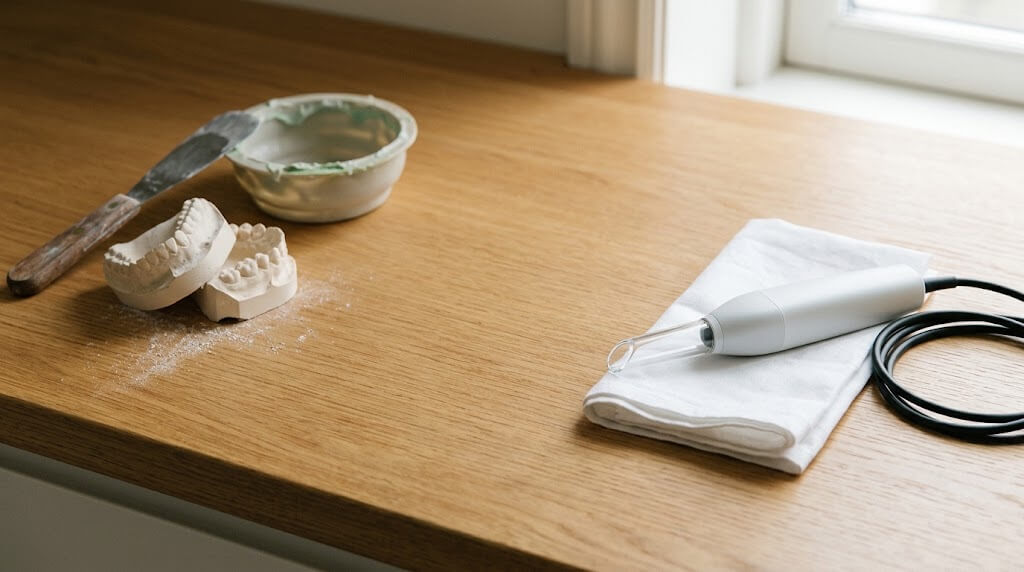
The digital dental scanner vs impressions question usually answers itself the first time you sit through both. One is a tray of thick putty held against your teeth while it sets. The other is a slim wand, a few minutes of gentle passes, and a 3D model of your mouth spinning on the monitor next to your chair.
360 Dental runs an all-digital practice at 6301 Van Nuys Blvd, so general dentistry visits here start with a scan rather than a tray. Patients notice the difference immediately. The part they do not see is what the scan makes possible afterward: aligner planning, crown design, and a permanent record of what your bite looked like on this exact day.
Below is what a 5D digital scan actually captures, how it compares to the tray it replaced, and what to expect at your own appointment in Van Nuys.
What Is a Digital Dental Scanner, and How Is It Different From an Impression Tray?
A digital dental scanner is a handheld wand that photographs your teeth thousands of times per second and stitches those frames into an accurate 3D model on screen. An impression tray captures the same anatomy physically, using a soft material that has to harden in your mouth first.
The end goal is identical. Your dentist needs an exact copy of your teeth and gums to design anything that has to fit them. How that copy gets made is where the two methods split.
With a tray, the model is a physical object. It can shrink slightly, pick up a bubble, or shift if you move while the material sets. With a scan, the model is data. Here is what a modern intraoral scan records in a single pass:
- Tooth shape and position for every visible surface, including the tight contacts between neighboring teeth.
- Gum contours and margins, which decide whether a crown edge sits flush or catches food.
- Your bite in motion, captured by scanning your teeth together so the lab sees how upper and lower actually meet.
- Full-color photographs of each tooth, useful for matching the shade of a veneer or a filling.
Why Did Dentists Move Away From the Old Impression Tray?
Dentists moved away from putty trays because the material itself limited what came next. Trays are uncomfortable for many patients, they capture one moment with no chance to check the result, and a flawed capture is often discovered days later at the lab rather than in the chair.
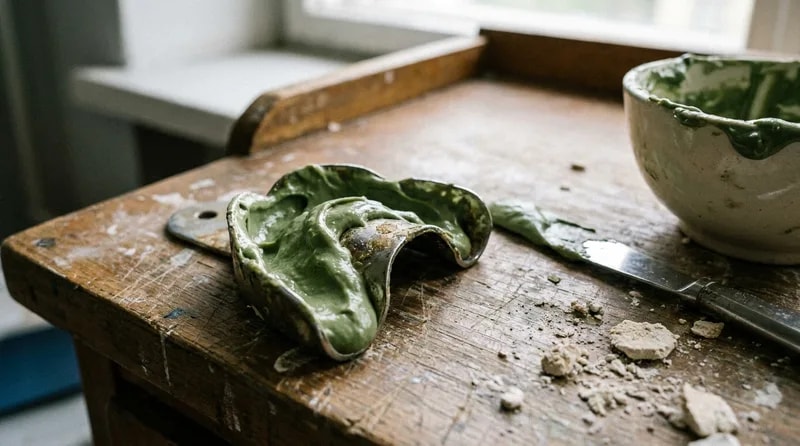
That last point costs real time. A distorted margin means a crown that does not seat properly, which means another visit. Patients who already dread dental work rarely volunteer for a repeat.
Anxiety is not a small factor here. Research published in BMC Oral Health in 2024 found that 36% of Americans have dental anxiety, and 12% have extreme dental fear. For a meaningful share of those patients, the tray was the specific trigger.
36%
of Americans have dental anxiety (BMC Oral Health, 2024)
12%
have extreme dental fear (BMC Oral Health, 2024)
80%
of oral health issues can be caught early at regular visits (ADA)
Three problems the tray created, in the order patients tend to feel them:
- The gag reflex. A full tray sits far back against the soft palate. Some patients manage it fine. Others cannot, and for them a scan is the difference between accepting treatment and postponing it another year.
- No instant quality check. Putty either worked or it did not, and nobody could zoom in to be sure.
- The waiting. A physical model has to be packed and shipped before design work starts.
What Actually Happens During a Digital Scan Appointment?
A digital scan takes roughly three to five minutes for both arches, and you stay upright with your mouth open only part of the time. Your hygienist or dentist glides the wand along the outer, inner, and biting surfaces of your teeth while the model builds live on the screen beside you.
No trays, no setting time, no waiting with your mouth full. If you need to swallow or rest your jaw, the scan pauses and picks up exactly where it stopped.
Here is the sequence from the chair:
- A quick dry and polish. Surfaces are cleared of saliva and plaque so the camera reads true detail.
- The lower arch. The wand traces biting surfaces first, then the tongue side, then the cheek side.
- The upper arch. Same pattern, usually a little faster because the team has your rhythm by now.
- Your bite. You close normally and the wand captures one side, then the other, registering how the arches meet.
- Review together. The model rotates on screen. Worn edges, a chipped corner, a receding gum line: you see what your dentist sees.
That last step changes the conversation more than the technology does. It is far easier to discuss a cracked molar you are looking at than one being described to you.
Digital Dental Scanner vs Impressions: How Do They Compare Side by Side?
Side by side, digital scanning wins on comfort, speed, and the ability to verify results in real time, while both methods can produce a well-fitting restoration in skilled hands. The practical gap shows up in remakes, record keeping, and how much you understand about your own mouth when you leave.
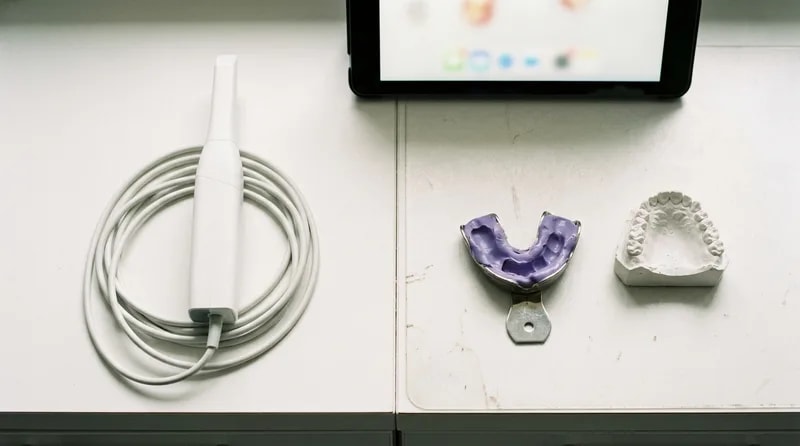
| What you notice | Putty impression tray | Digital intraoral scan |
|---|---|---|
| Time in the chair | Several minutes per arch while the material sets | Roughly 3 to 5 minutes for both arches, with pauses whenever you want |
| How it feels | Full tray, thick material, common gag reflex | A slim wand the size of an electric toothbrush head |
| Seeing your own results | You see a putty mold, not your teeth | A rotating 3D model on the monitor beside you |
| Fixing a flawed capture | Often a second tray, sometimes a second visit | Rescan the one area on the spot, in seconds |
| Getting it to the lab | Physical model boxed and shipped | Encrypted file sent the same day |
| Comparing visits over time | Stored models warp and are rarely revisited | Old and new scans overlay to show what moved or wore down |
| Radiation | None | None. Intraoral scanners work with visible and near-infrared light |
Notice the last row. Neither method involves radiation, which surprises patients who assume any screen-based imaging means X-rays. That is a separate technology, covered further down.
What Does the 5D in 5D Digital Scanning Actually Add?
The 5D label refers to a newer generation of intraoral scanner that layers three kinds of imaging into one pass: the 3D surface scan, full-color intraoral photographs, and near-infrared imaging, or NIRI, which looks just beneath the enamel for signs of decay between teeth.
Think of it as three tools folded into the wand you were already holding. The 3D scan handles fit. The color camera handles shade matching and patient conversations. NIRI adds a screening layer that can flag early interproximal decay, the kind that starts in the tight space between two teeth where a mirror cannot reach.
The National Institute of Dental and Craniofacial Research describes decay as a process that begins with enamel losing minerals, long before a visible hole forms. That early window is exactly what a screening layer is looking for.
NIRI is a screening aid, not a verdict. Near-infrared light does not replace radiographs or a clinical exam, and findings still need a dentist's interpretation. What it does well is start a conversation earlier. Catching demineralization before it becomes a cavity often means a smaller repair, and per the Mayo Clinic, tooth decay progresses through predictable stages that respond better to early intervention.
See your teeth the way your dentist does
360 Dental pairs iTero digital scanning with 3D CT imaging, so your exam, diagnosis, and treatment plan happen in one visit at Van Nuys Blvd and Victory Blvd.
Which Treatments Start With a Digital Scan at 360 Dental?
Most treatments that involve anything custom-made now begin with a scan. That includes clear aligners, crowns and bridges, veneers, night guards, dentures, and implant restorations. One scan often serves several purposes, which is part of why the practice keeps it on file.
A few examples of how the same file gets used:
- Invisalign and clear braces. Aligner therapy depends entirely on an accurate starting model. Clear aligners can treat 90% of mild-to-moderate alignment issues according to the American Journal of Orthodontics, and average treatment runs 6 to 18 months versus 18 to 36 for traditional braces, per the AAO. Your scan is what makes that timeline predictable.
- Crowns, bridges, and veneers. Margins are designed against the scan, and the color photographs help match neighboring teeth.
- Dental implants. Here the intraoral scan is combined with 3D CT imaging so bone and soft tissue are planned together. Implants carry a 95% to 98% success rate over ten years per the Journal of Oral and Maxillofacial Surgery, and planning accuracy is a large part of that.
- Night guards. A guard has to fit closely or it gets left in a drawer.
- Dentures and full mouth reconstruction. Multi-step cases lean hardest on records that can be compared visit to visit.
Related: Digital records are also the starting point when several treatments are combined into one plan. How Dr. Danoukh plans a smile makeover →
Is a Digital Scan Safe, and Does It Use Radiation?
No, an intraoral digital scan does not use radiation. Scanners capture your teeth with visible light and near-infrared light, the same category of light you meet every day. Nothing is injected, nothing sets in your mouth, and the wand touches only tooth and gum surfaces.
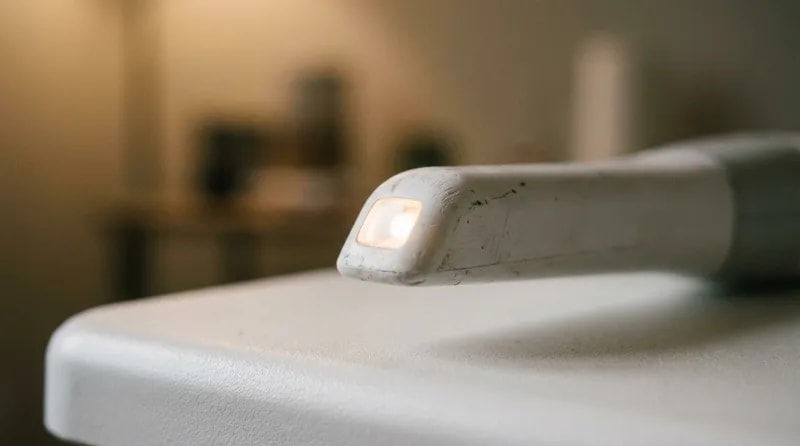
The confusion is understandable, because dental offices use two different digital systems. A 3D CT scan is a low-dose X-ray that shows bone, sinuses, and nerve pathways, and it is used when planning implants or assessing an infection. An intraoral scan maps only surfaces. They answer different questions and are often used together.
- Common assumption
"If it shows up on a screen, it must be an X-ray." Many patients assume any digital imaging means radiation exposure.
- What is actually true
Intraoral scanners use visible and near-infrared light only. Radiation comes from radiographs and 3D CT, which are separate tools ordered for different reasons.
When radiographs are part of your visit, they follow established professional guidance on frequency and shielding. The American Dental Association publishes guidance on dental radiograph use, and your dentist orders images based on your history rather than on a fixed schedule.
MouthHealthy, the ADA's patient education site, explains what each type of dental image is used for, which is a useful read before your first visit if imaging makes you uneasy.
Practical note for anyone with a sensitive gag reflex or jaw tension: tell the team before the wand comes out. Scans can be broken into short segments. Patients managing TMJ discomfort often prefer several brief passes over one continuous one.
What Should Van Nuys Patients Ask Before Their First Digital Scan?
Ask whether your visit includes a digital scan or a putty tray, and ask to see the model on screen before you leave. Those two questions tell you a lot about how a practice works. Also worth asking: whether the scan is stored as a baseline you can be compared against later.
Not every office in the San Fernando Valley has gone fully digital, and some use scanners for aligner cases only while keeping trays for crowns. Neither approach is wrong. But knowing which one you are walking into helps you plan your appointment, especially if trays have been difficult for you in the past.
Ask these before your first scan
Check each item you have completed.
I asked whether my visit uses a digital scan or a putty tray.
I asked to see my 3D model on the screen before I leave.
I mentioned my gag reflex or jaw discomfort so the team can pace the scan.
I asked whether the scan is kept as a baseline for future visits.
I confirmed the scan is included in my exam and not a separate charge.
I asked which treatments my scan can be reused for later.
Your score: count your checks out of 6
360 Dental sits at Van Nuys Boulevard and Victory Boulevard, minutes off the 405 and the 101, and sees patients from Sherman Oaks, North Hollywood, Encino, Panorama City, and Valley Glen. The team speaks English, Spanish, and Armenian. Scanning is standard for exams here rather than an upgrade, and the same visit can include diagnosis and a treatment plan because the endodontist, Dr. Parham Mansouri, DDS, MS, works in the same building.
Visiting 360 Dental in Van Nuys
- Where
6301 Van Nuys Blvd Van Nuys, CA 91401 At Van Nuys Blvd and Victory Blvd, minutes off the 405 and 101
- Hours
Mon to Thu: 8:30 AM to 5:30 PM Fri: 8:30 AM to 4:00 PM Sat and Sun: Closed
- Good to know
Phone: (818) 787-6400 English, Spanish, and Armenian spoken All PPO plans accepted
What Should You Do With This Information?
The real value of the digital dental scanner vs impressions shift is not comfort, welcome as that is. It is that you now leave your appointment having seen your own teeth at high magnification, with a dated record that your next visit can be measured against.
That changes the ask from "trust me" to "look at this." A worn edge you can see is a worn edge you will actually do something about, ideally while the fix is still small.
If you have been putting off a visit because of a difficult experience with impression trays, that specific obstacle is gone. Call (818) 787-6400 or request an appointment online, and ask for the scan on screen when you arrive.
Results may vary. Please consult with your dentist at 360 Dental for personalized treatment recommendations.
Start with a scan, not a tray
Book a new patient exam at 360 Dental in Van Nuys and see your 3D model the same visit. All PPO plans accepted, with CareCredit, Sunbit, and Cherry financing available.
Questions about your visit, insurance, or the 360-VIP membership club? The front desk is happy to walk you through it.
Common questions
Is a digital dental scanner more accurate than impressions?
Both methods can produce a well-fitting restoration, but a digital scan lets your dentist verify the capture immediately and rescan a single area in seconds. Putty models can shrink, trap a bubble, or shift while setting, and the flaw often surfaces later at the lab.
Is a digital dental scanner uncomfortable or likely to trigger gagging?
A scan involves no tray and no setting material, so gagging is far less common. The wand is about the size of an electric toothbrush head, and the scan pauses whenever you need to swallow. Tell your team in advance about any sensitivity.
How long does a digital dental scan take?
Roughly three to five minutes for both arches, including the bite registration. Reviewing the 3D model on screen with your dentist adds a few more minutes, and that review is usually the most useful part of the appointment.
What does 5D mean in 5D digital scanning?
It refers to a scanner generation that combines three imaging types in one pass: the 3D surface scan, full-color intraoral photographs, and near-infrared imaging that looks just under the enamel for early decay between teeth.
Does a digital dental scanner use radiation?
No. Intraoral scanners work with visible and near-infrared light, not X-rays. A 3D CT scan is a different tool that does use low-dose radiation, and it is ordered when bone, sinuses, or nerve pathways need to be assessed.
Can a digital scan replace my dental X-rays?
No. Near-infrared imaging screens for early decay between teeth, but it does not show bone levels, root anatomy, or infection below the gum line. Your dentist decides which radiographs are needed based on your history.
Is digital scanning available at 360 Dental in Van Nuys?
Yes. 360 Dental is an all-digital practice at 6301 Van Nuys Blvd, using iTero digital scanning along with 3D CT imaging. Scanning is standard for exams rather than an upgrade, so diagnosis and planning often happen in one visit.
Does insurance cover a digital scan instead of impressions?
Coverage follows the procedure the scan supports, such as a crown or aligner case, rather than the capture method itself. 360 Dental accepts all PPO plans and offers CareCredit, Sunbit, and Cherry financing, plus the 360-VIP membership club.
Did this answer your question?
Written for general reading, not as advice about your own teeth. Nothing here replaces an examination: if something hurts, or has changed, book a visit and let a dentist look at it.
Your first visit
One ticket covers it.
360 Dental · Admit one